Here’s the thing: in customer education, everything is already custom. You’re teaching your product, your workflows, your unique features. So the question isn’t “off-the-shelf vs custom” (that debate doesn’t apply here). The real question is: are you approaching custom eLearning development strategically with Learning Experience Design—or just creating content?
Let’s be real: “we built some tutorials” and “we designed a learning experience that drives adoption” are not the same thing. One generates views (think Netflix binge, but not in a good way). The other moves metrics (hello, lower time-to-value, higher retention).
What Custom eLearning Development Really Means for Customer Education
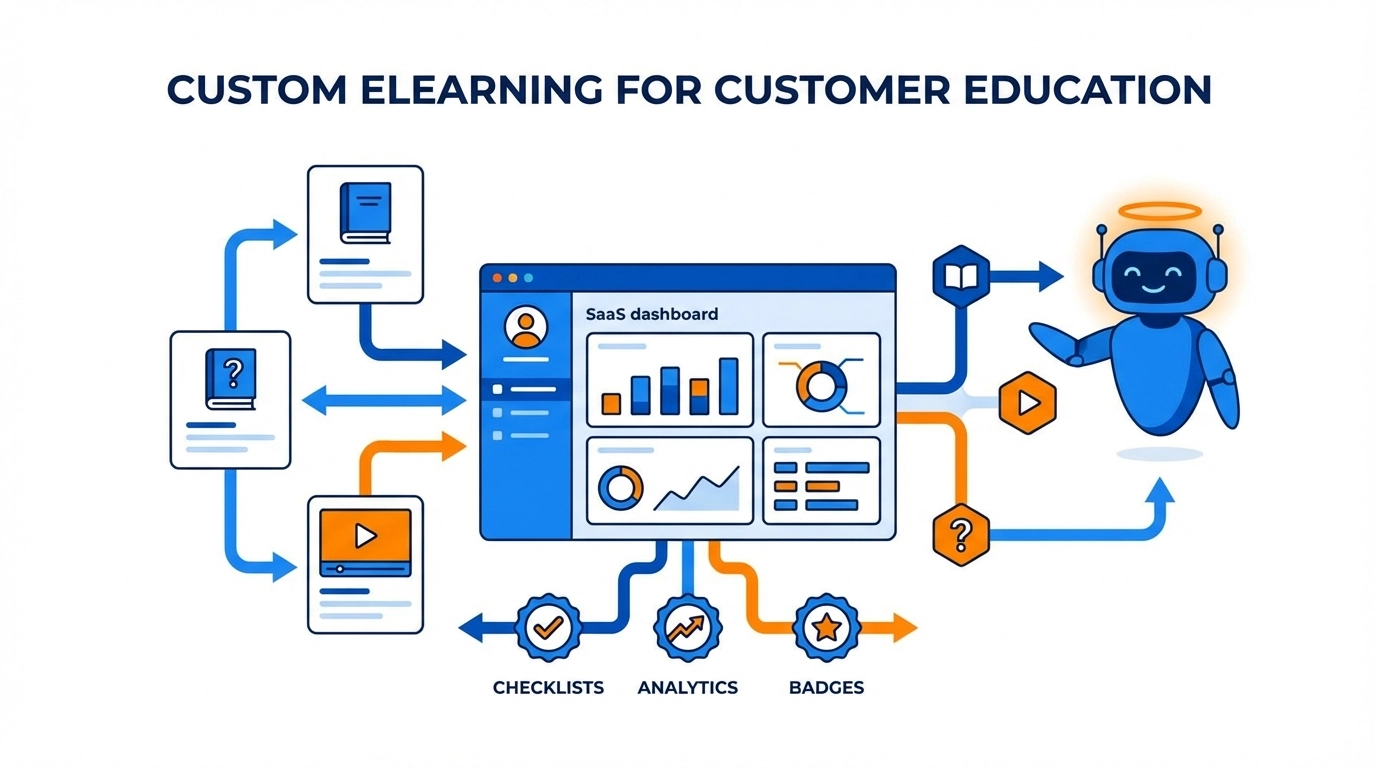
Custom eLearning development isn’t a logo on a template. It’s the deliberate design of learning around customer jobs-to-be-done, real product contexts, and measurable outcomes. Why does this matter? Because in customer education, relevance equals results.
In 2026, custom eLearning development for customer education looks like:
- AI-personalized paths aligned to roles and use cases (admin vs end-user vs exec sponsor)
- Workflow-level simulations that mirror your product environment and data
- Embedded, just-in-time guidance inside the product (contextual help, smart tooltips)
- Analytics that tie learning to product adoption, retention, and expansion
Customer education scenarios to prioritize:
- Product adoption journeys by persona and plan tier
- Onboarding sequences from sign-up to first value (and beyond)
- Feature-release training that drives usage within 7–14 days of launch
- Customer certification programs that validate capability and reduce support handholding
- Education-led support deflection for high-volume ticket themes
- Renewal and expansion playbooks that upsell via skills pathways
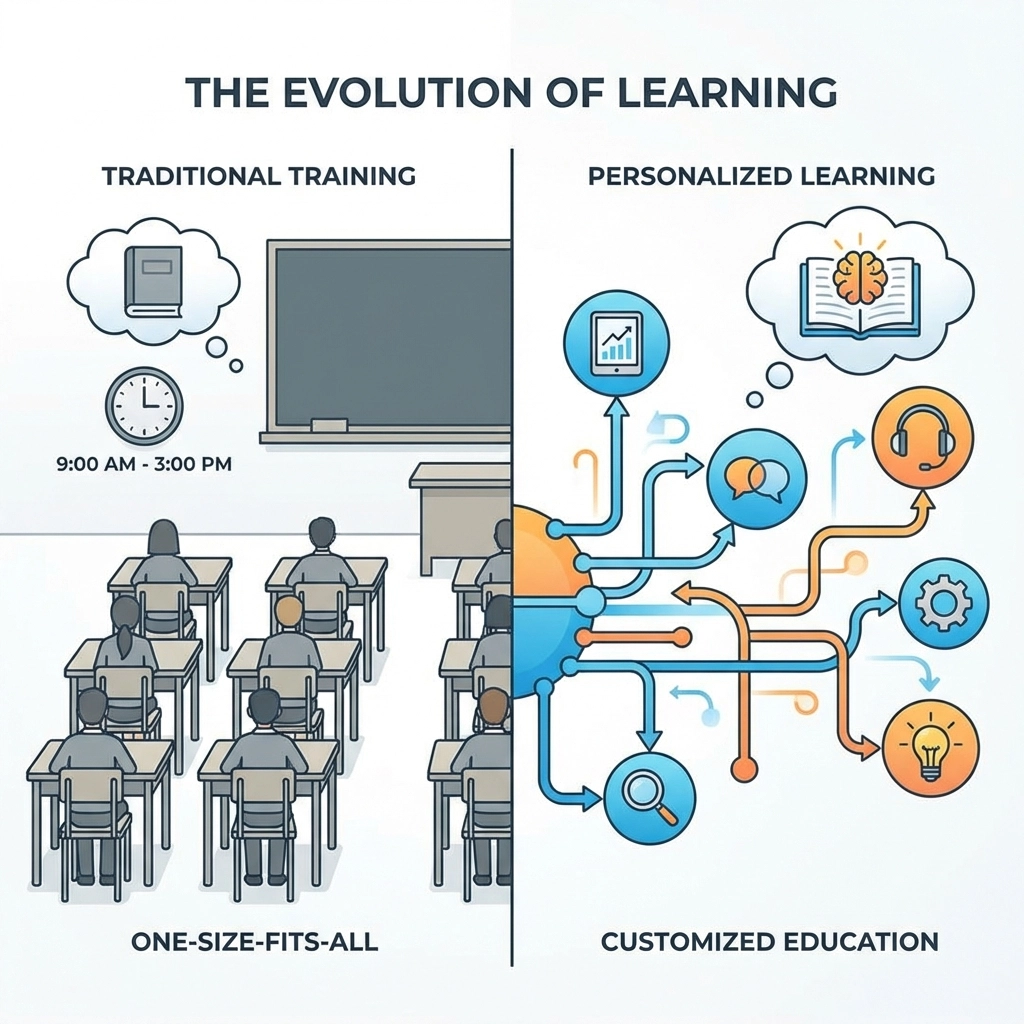
If you’re thinking “we already make custom content,” ask: What’s the real impact? Are you reducing support tickets, accelerating onboarding, and driving feature adoption—or just shipping modules?
Customer education metrics that matter:
- Product adoption rate (by feature, by cohort)
- Time to first value (TTV) and time to competency by persona
- Support ticket reduction and self-serve rate
- CSAT/NPS after onboarding and after feature releases
- Renewal rate and contraction vs expansion MRR
- Learning → product correlation (e.g., completion → activation → usage depth)
Three Approaches to Custom eLearning Development (and When Each Fits)
Here’s the deal: the distinction isn’t custom vs not—it’s how you execute custom eLearning development. There are three common approaches.
1) Basic DIY Custom eLearning Development
- What it is: Internal teams cobbling together help docs, Loom videos, and basic walkthroughs (we see you!).
- When it fits: Early-stage, simple products, small audiences, rapid iteration needed.
- Risks: Inconsistent quality, weak pedagogy, hard to scale, low engagement.
- Customer education reality: DIY works for quick-release notes and hotfix explainer clips—but it rarely shifts activation, adoption, or renewal.
- Signals you’re here: Lots of content, little behavior change. Support still spikes after “training.” CSMs re-explain the same flows on every call.
2) Template-Based Rapid Custom eLearning Development
- What it is: Authoring tools (Articulate, Captivate) with templates and light interactivity.
- When it fits: You need speed, light personalization, and a short shelf life (launch months, beta cycles).
- Risks: Surface-level learning, template fatigue, limited data depth.
- Customer education reality: Good for consistent onboarding checklists and short role intros, but doesn’t deliver deep product practice.
- Signals you’re here: Clean courses, modest engagement, limited impact on activation or adoption. Feature usage barely moves post-course.
3) Professional Custom eLearning Development with LXD
- What it is: Research-driven Learning Experience Design that ties learning to product and business outcomes.
- When it fits: You need scale, measurable impact, and stakeholder alignment with CS, Product, and PMM.
- Strengths: Role-based pathways, scenario design, product-integrated practice, analytics that map to KPIs.
- Customer education reality: This is where TTV drops, adoption climbs, and renewals thank you.
- Signals you’re here: Faster time-to-value, higher feature adoption, fewer tickets, happier CSMs—and PMs who finally see measurable lift post-release.
Bottom line: all three are “custom.” Only the third turns custom eLearning development into a strategic lever for customer education and customer success.
Why Learning Experience Design Elevates Custom eLearning Development
Let’s face it: information transfer is easy; behavior change is hard. Learning Experience Design (LXD) makes custom eLearning development effective by focusing on:
- Outcomes first: Define success behaviors and measurement criteria up front (activation targets, daily/weekly active usage, renewal guardrails).
- Context always: Build around real product workflows and customer scenarios (not abstract demos).
- Cognitive science: Spaced practice, retrieval, and feedback loops (not trivia quizzes for gold stars).
- Experience design: Emotion, pacing, and UI that reduce friction and boost motivation.
- Time-to-competency: Design sprints that compress the path from “new user” to “proficient user” without flooding people with noise.
Customer education-specific LXD in action:
- Persona-driven narratives (admins configuring permissions vs analysts building dashboards vs execs reviewing insights)
- Progressive learning paths aligned to maturity (Starter → Pro → Power User)
- Embedded education in the product (contextual nudges, micro-lessons triggered by behaviors)
- Assessment as enablement (tasks that mirror real work, not just knowledge checks)
At Check N Click, we apply LXD across ADDIE and SAM (we blend the models, not worship them). We’ve delivered 1000+ hours of custom eLearning development for SaaS and enterprise, and the difference shows up in the metrics customer education leaders report to the board.
Designing Effective Customer Education with Custom eLearning Development
Don’t try to build “courses.” Design a system. Use this playbook:
- Define the outcomes
- Target metrics: activation, time-to-first-value, feature adoption, renewal rate, expansion MRR.
- Behavioral indicators: what successful users do differently (e.g., create 3 dashboards within 7 days; automate 2 workflows by week 2).
- Segment by jobs-to-be-done
- Roles, expertise, and use-case clusters (admin vs analyst vs integrator).
- Plan tiers and verticals (Enterprise healthcare vs SMB retail need different depth and compliance signals).
- Map the journey
- Onboarding → first value → expansion. Place learning at friction points (hello, endless Zendesk tickets).
- Define critical “aha” moments and the learning that unlocks each step.
- Build practice that mirrors the product
- Simulations, guided walkthroughs, safe sandboxes, and scenario branching.
- Use customer-like datasets so practice feels real.
- Embed learning in the flow
- In-product prompts, contextual help, micro-lessons triggered by behavior.
- Release training as in-app journeys within 24–72 hours of launch.
- Track and optimize
- Instrument learning with analytics that connect to product telemetry (Amplitude, Mixpanel, Pendo).
- Run A/B tests on learning paths; iterate monthly.
Feature release training playbook (CE edition):
- Teaser and “why it matters” narrative tied to use cases
- 5–7 minute role-based micro-lessons + in-product walkthrough
- Quick practice task with auto-feedback
- Adoption KPI: % of target users using feature 3+ times in 14 days
Customer certification blueprint:
- Role-based exams mapped to real workflows
- Hands-on labs or graded tasks using a sandbox
- Badges that unlock advanced content and community privileges
- Outcomes: reduced escalations, increased self-sufficiency, proof for partner programs
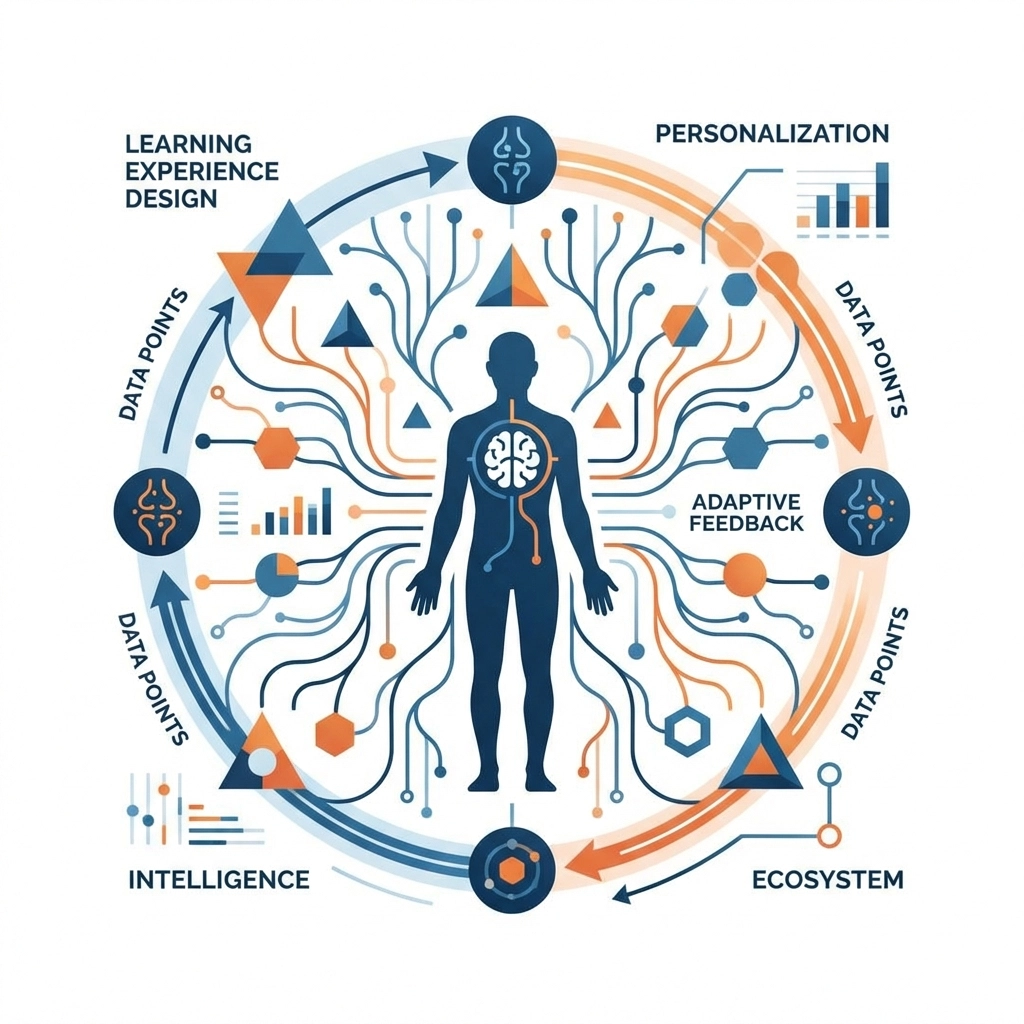
We’ve seen well-designed custom eLearning development reduce support volume by up to 40% and increase feature adoption by 60% in SaaS contexts—backed by our work on customer education strategies. Expect tighter TTV and better renewal health scores when education is built into the journey.
From “Custom Content” to Strategic LXD: What’s the Real Difference?
Ask these questions to see where you are:
- Is every module tied to a KPI and a job-to-be-done?
- Can learners practice exactly what they’ll do in your product?
- Do you personalize by role, maturity, and use case?
- Can you show causation (or at least strong correlation) between learning and product outcomes?
- Are you iterating based on usage and outcome data?
If the answers skew “no,” you’re making content, not orchestrating learning. The fix is LXD-led custom eLearning development that ladders into customer success goals: activation, adoption, advocacy.
Real-World Applications: Custom eLearning Development That Moves Metrics
Let’s talk about impact.
SaaS onboarding overhaul
- Problem: 15% tutorial completion; 45 days to first value.
- Custom eLearning development with LXD: Role-based simulations using a product sandbox, adaptive hints for complex steps, fast-tracks for experienced users.
- Results: 78% completion, 12 days to value, 3x feature adoption at six months. CSAT rose 9 points; new-logo renewals improved by 6%.

Global partner enablement
- Problem: Costly live workshops; uneven integration quality across regions.
- Custom eLearning development with LXD: Branching integration scenarios, editable code labs, peer collaboration, analytics to target gaps.
- Results: 60% lower training cost, 45% higher competency. Partners learned on their schedule—with real-world practice. Ticket escalations dropped 32%.
Feature release training (enterprise analytics)
- Challenge: New forecasting feature stalled at 12% usage 30 days post-launch.
- Solution: Role-based micro-journeys in-app + 10-minute scenario lesson + “first forecast” guided task.
- Outcomes: 38% usage within 14 days, 2.1x increase in weekly active forecasters, uplift in expansion pipeline attributed to feature.
Customer certification program (B2B fintech)
- Challenge: Heavy onboarding burden on CS; slow adoption in regulated workflows.
- Solution: Proctored, role-based certification with sandbox exercises and renewal badges.
- Outcomes: 27% reduction in time-to-competency, 22% support ticket deflection, renewal rate +4.5% in certified cohorts.
Support deflection through education (SaaS ops)
- Challenge: High-volume tickets on permissions and SSO setup.
- Solution: Troubleshooting decision trees + interactive setup labs embedded in help center and product.
- Outcomes: 41% fewer tickets on those themes, median resolution time down 36%.
Explore more in our case studies.
Choosing the Right Partner for Custom eLearning Development
Here’s the reality: many “custom” vendors sell templates with your logo. Look for:
- Instructional/LXD depth: Learning science first, tech second. Our work builds on adaptive design, ADDIE, and the SAM model.
- Industry fluency: SaaS workflows, compliance, telemetry—no generic filler.
- Tech-agnostic builds: Choose tools for objectives, not vendor kickbacks.
- Analytics baked in: Define success, measure continuously, iterate deliberately.
- Product analytics integration: Connect learning to product data (e.g., Mixpanel, Amplitude, Pendo) for real adoption insight.
- Multi-surface delivery: Academy + in-product + community + help center, all singing the same song.
- Collaborative build: SMEs in the loop; prototypes early and often.
With 13+ years in custom eLearning development, we start with alignment: outcomes, audiences, and the measurement model that will prove ROI to your CS and revenue teams.
Future Trends Shaping Custom eLearning Development
- AI-driven personalization: Paths adapt in real-time to usage and performance (and to customer maturity stages).
- Agentic AI tutors: Context-aware guidance, hints, and feedback in the flow—like a CSM sidekick inside your product.
- Microlearning, mobile-first: Snackable, outcome-tied units aligned to jobs that push adoption, not just awareness.
- Skills and micro-credentials: Verify capability, not just completion; turn badges into community status and partner requirements.
- Unified analytics: Connect learning data to product analytics for clear ROI, renewal forecasting, and expansion signals.
- Release enablement at scale: Auto-generated starter lessons and in-app tours tied to release notes within 24 hours.
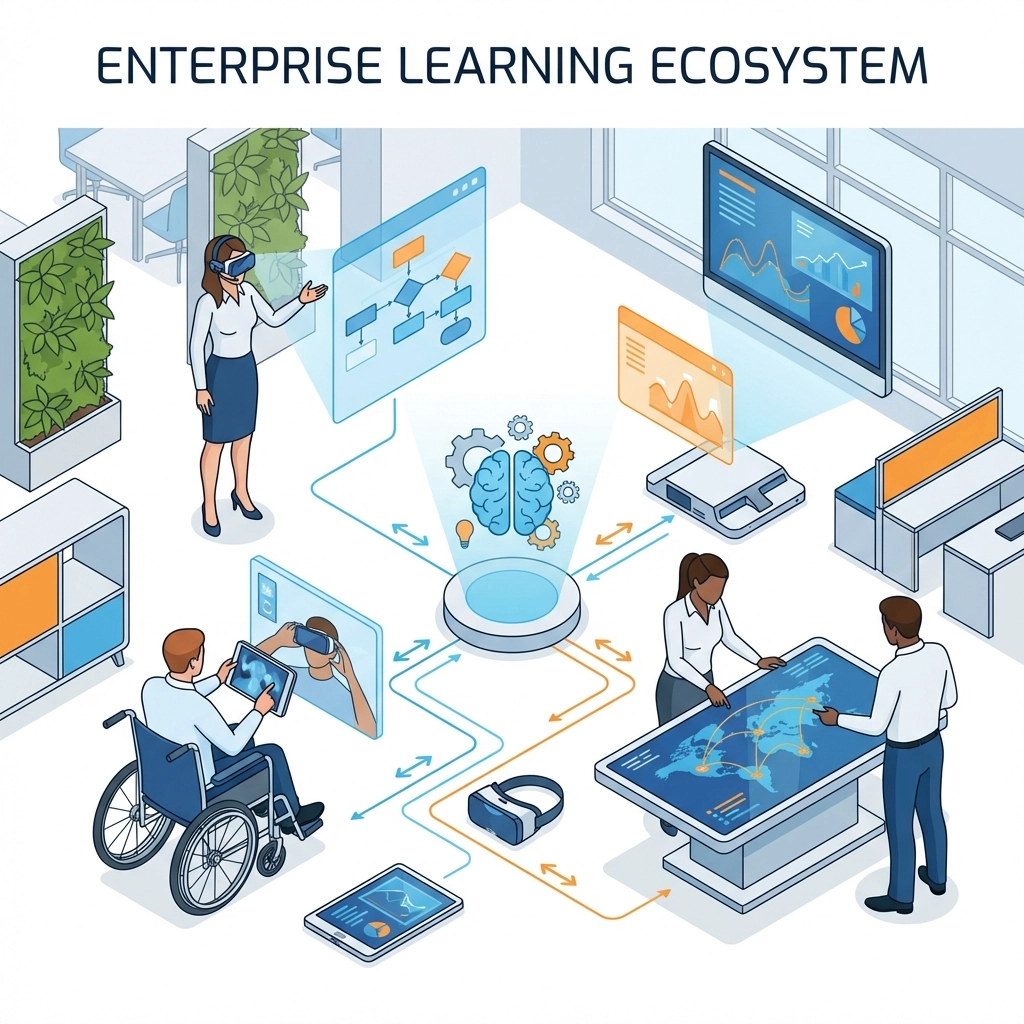
Planning ahead? See how leaders are future-proofing customer education strategies for 2026.
Getting Started with Custom eLearning Development (Without the Overwhelm)
We get it—this can feel big. But here’s the good news: you don’t need to boil the ocean.
Start with:
- A focused audience segment and one high-impact workflow
- A measurement plan that ties learning to product KPIs
- A pilot that proves lift in 4–6 weeks
Do this first:
- Map support ticket themes to learning moments.
- Prioritize features with high impact but low adoption.
- Draft a content calendar and competitive analysis for your academy.
- Build a minimal LXD blueprint: outcomes, segments, journey, analytics.
- Set your CE dashboard: activation %, TTV by persona, feature adoption depth, ticket deflection, CSAT post-onboarding, renewal/expansion by educated cohort.
Measure relentlessly:
- Track activation, TTV, adoption, and churn signals—not just completions.
- Correlate learning cohorts with product usage and renewal health scores. If you’re not instrumented, you’re flying blind.
For deeper guidance, grab our complete guide to customer education. Want hands-on help? Visit https://check-n-click.com to book a 30-minute LXD consult and get a tailored blueprint for your next release—including a feature-release enablement kit and a certification pilot plan.
Custom eLearning development in 2026 isn’t about making more content. It’s about designing experiences that transform how customers use—and love—your product. Start small, measure big, and scale what works. Your customers (and your CSMs) will thank you.
The question isn’t whether you need custom eLearning development—you already do. It’s whether you’re using LXD to make it strategic, measurable, and undeniably effective for customer education and customer success.