Explore the battle between learning in the flow of work and traditional customer education. Discover the hybrid strategy that drives SaaS success in 2026.
Customer Education is changing fast, and learning in the flow of work is redefining how SaaS users actually learn your product (without rage-quitting to hunt for a 47-minute video).
Let’s be real: your users don’t want to sit through another long onboarding module when they’re trying to export a CSV file right now. But does that mean you should scrap your entire Customer Education program and go all-in on tooltips and walkthroughs?
Here’s the thing, it’s not that simple.
After 13+ years building Customer Education ecosystems for Fortune 500 companies at Check N Click, I’ve watched this debate play out in dozens of boardrooms. The answer isn’t “either/or.” It’s “both/and”, if you know when to use each approach.
Let’s break it down.
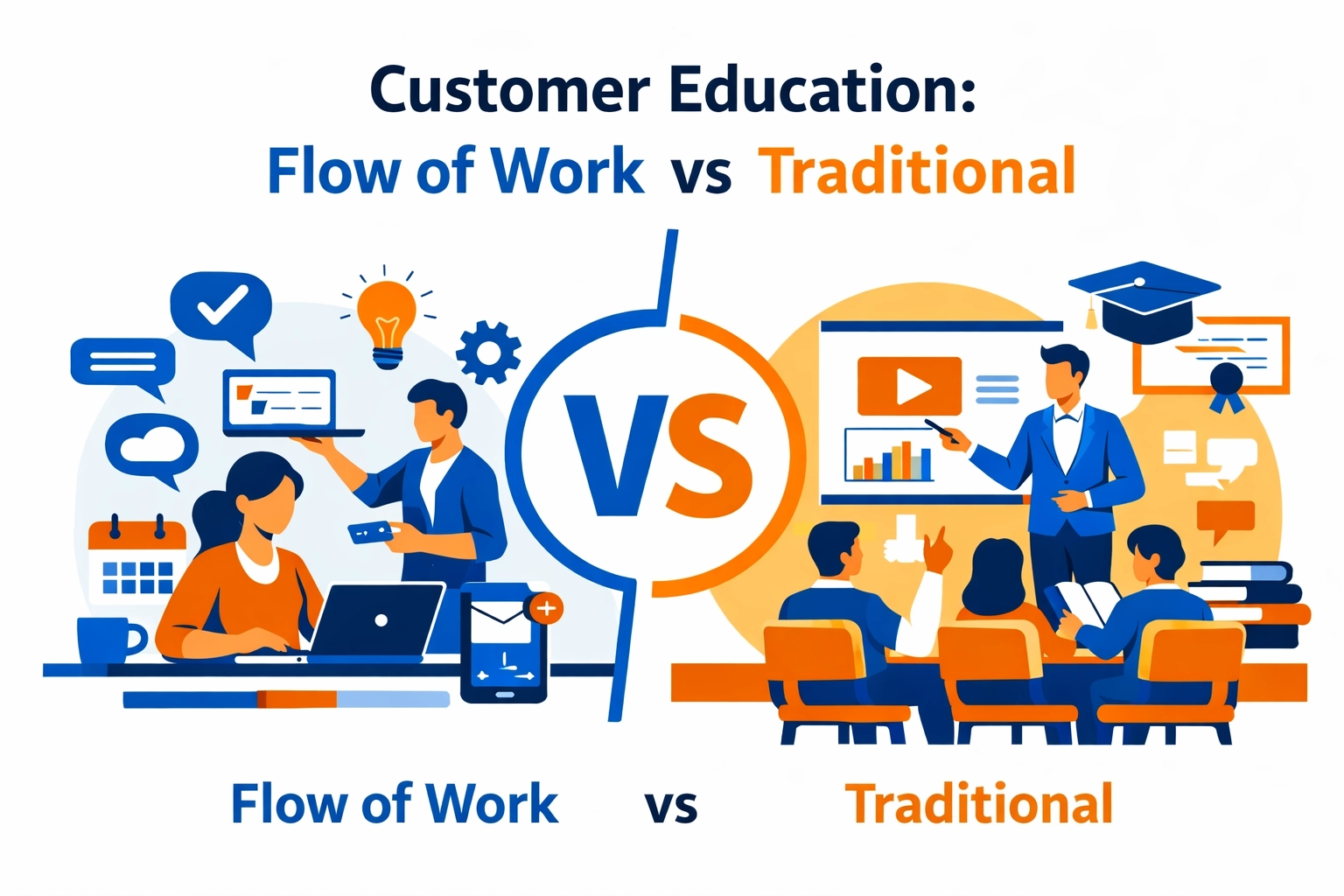
The Clash: Two Worlds of Customer Education
Think of traditional customer education as the “classroom model.” You’ve got your structured LMS courses, certification paths, video libraries, and knowledge bases. Users stop what they’re doing, enter “learning mode,” and consume content in a linear, often scheduled format.
Learning in the flow of work (LITFOW), on the other hand, is the “Netflix subtitle” of training. It’s contextual, in-app guidance that shows up exactly when users need it, interactive walkthroughs, tooltips, embedded help, smart nudges. No course enrollment required. No switching tabs. No hunting through documentation that was last updated when your product had half the features it does now.
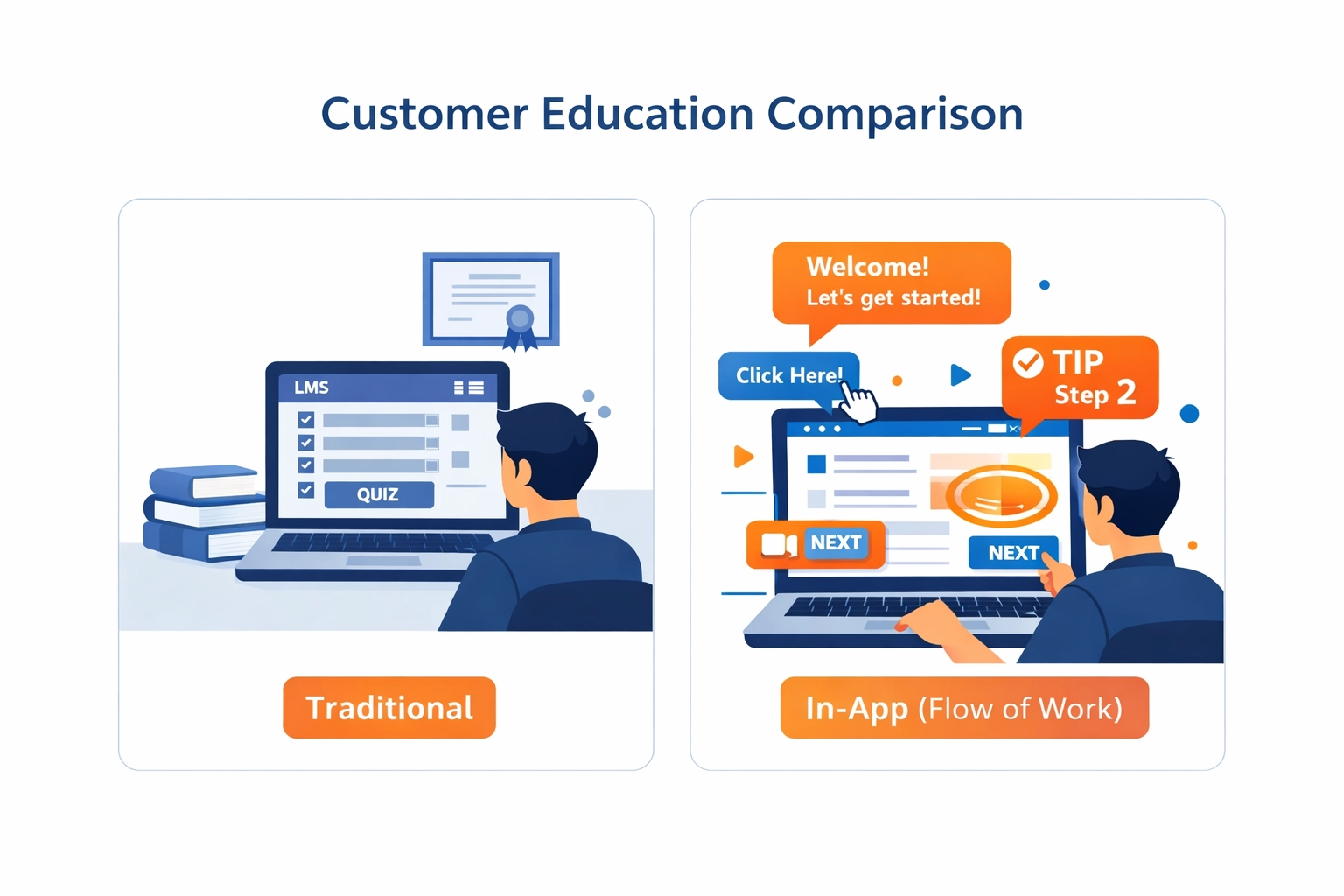
Here’s how they stack up:
| Traditional Education | Learning in the Flow of Work |
|---|---|
| External LMS platforms, scheduled sessions | In-app, contextual, at the moment of need |
| One-size-fits-all content | Personalized to role and task |
| Text-heavy documentation | Interactive, self-service guidance |
| Often outdated with product releases | Real-time, always current |
| Fixed training schedules | Self-paced, on-demand |
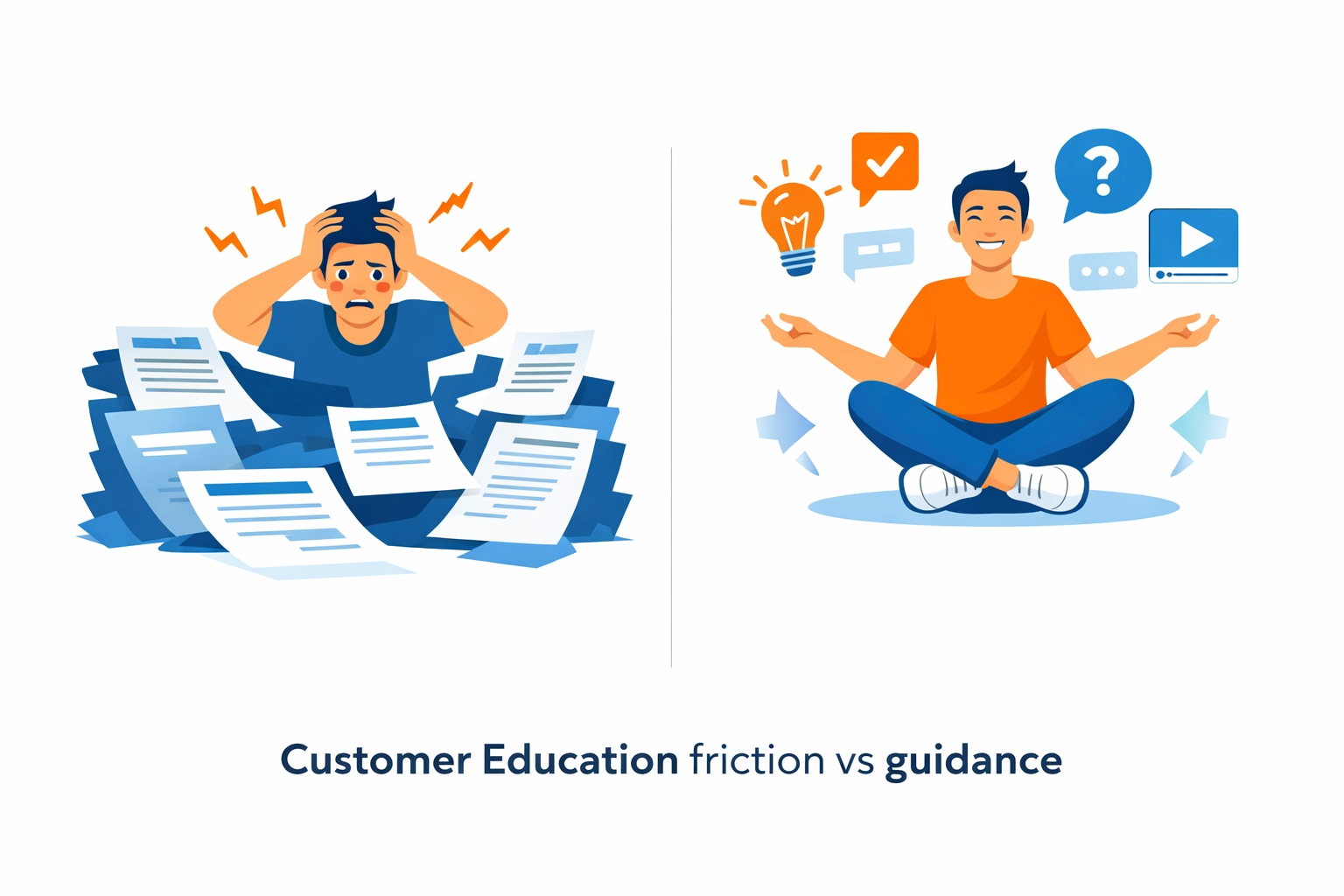
The friction is obvious. Traditional education asks users to leave the product to learn the product. That’s like pausing a road trip to read the car manual.
Why SaaS Users Are Abandoning Traditional Customer Education Models
Let’s talk about what’s really happening in your user base (hello, endless support tickets).
Fatigue is real. Your users are drowning in long videos, dense PDFs, and training modules that feel like homework. Research shows that traditional documentation creates “obstacle courses” rather than learning paths, lengthy text, jargon-heavy language, and maze-like navigation turn users into passive spectators instead of active learners.
They need answers now, not next Tuesday. When someone’s stuck in the middle of a workflow, they’re not going to bookmark the problem and come back after completing a 45-minute course. They’ll either Google it (and maybe find a competitor’s solution), bug your support team, or just… give up and not use that feature. Ever.
The friction kills adoption. Every extra click, every tab switch, every “let me watch this tutorial first” moment is a drop-off point. Companies that implement in-app education see massive reductions in first-90-day support tickets and higher conversion from trial to paid users.
And here’s the kicker: your product changes faster than your documentation. SaaS releases often outpace doc updates, which means you’re accidentally sending users down outdated paths. In-app guidance stays current because it’s part of the product itself.
But Wait, Traditional Customer Education Still Has Its Place in Customer Education
Before you delete your entire LMS and fire your instructional design team (please don’t), let’s pump the brakes.
Deep conceptual understanding doesn’t happen in tooltips. If you’re teaching complex workflows, strategic decision-making, or foundational product concepts, users need space to think: not just do. A 90-second walkthrough can show someone how to create a workflow automation. It can’t teach them when and why they should use it, or how it fits into their broader business strategy.
Certification and credibility matter. For enterprise users, partner training, or professional services, formal certification paths drive revenue. A badge from a structured course carries weight. A “completed walkthrough” notification? Not so much.
Some learning is aspirational, not urgent. Not every user is in crisis mode. Power users, admins, and champions want comprehensive training that helps them master your product. They’re the ones who’ll actually complete your 12-module certification program: and they’re the ones who’ll advocate for you internally.
Compliance and record-keeping are non-negotiable. In regulated industries, you need proof that users completed specific training. That’s hard to do with ambient, just-in-time guidance.
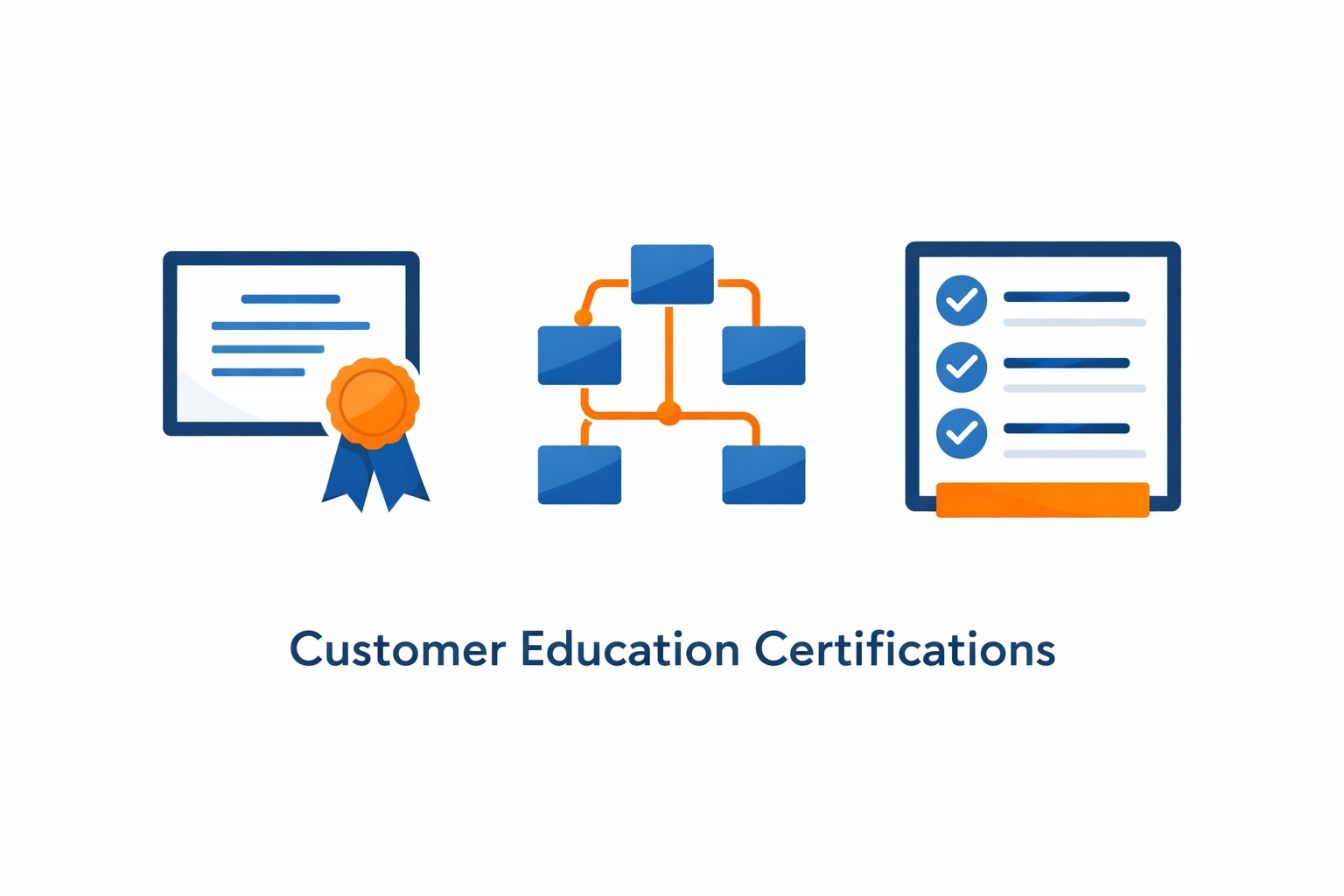
At Check N Click, we’ve spent years building Customer Education programs for global enterprises. Here’s what we’ve learned: the companies that win don’t pick a side. They build a hybrid Customer Education ecosystem where both approaches work in harmony.
Think of it this way:
- Traditional education is your foundation: the “textbook” that builds conceptual understanding.
- Learning in the flow of work is your safety net: the “cheat sheet” that catches users when they’re stuck.
The magic happens when they talk to each other. Your in-app walkthrough can link to a deeper course module. Your LMS course can prompt users to try a guided workflow in the product. Your certification path can include both structured lessons and hands-on, in-app assessments.
We’ve built these ecosystems for Fortune 500s across SaaS, healthcare, and finance. The ROI is clear: better adoption, lower support costs, and measurably higher retention. (Want to see the numbers? Check out our ROI calculator.)
The key is strategic alignment. Don’t build in-app guidance because it’s trendy. Build it because it solves a specific problem at a specific moment in the user journey.
Your Customer Education Decision Framework: When to Use What
Here’s a simple rule of thumb to decide which approach fits each learning moment:
Use Learning in the Flow of Work when:
- Users are actively trying to complete a task (onboarding, feature adoption)
- The knowledge is procedural (“how to export a report”)
- The content needs to stay current with rapid product changes
- You’re solving an immediate friction point
- You want to reduce support tickets for repetitive questions
Use Traditional Customer Education when:
- Users need foundational, conceptual knowledge (“What is a workflow automation?”)
- You’re building certification or credentialing programs
- The topic requires deep thinking or strategic planning
- You need compliance documentation and proof of completion
- You’re training power users, admins, or partners who want mastery
Use both when:
- Onboarding new enterprise accounts (structured training + in-app reinforcement)
- Launching new features (announcement course + contextual walkthroughs)
- Supporting advanced troubleshooting (knowledge base articles + guided diagnostics in-app)
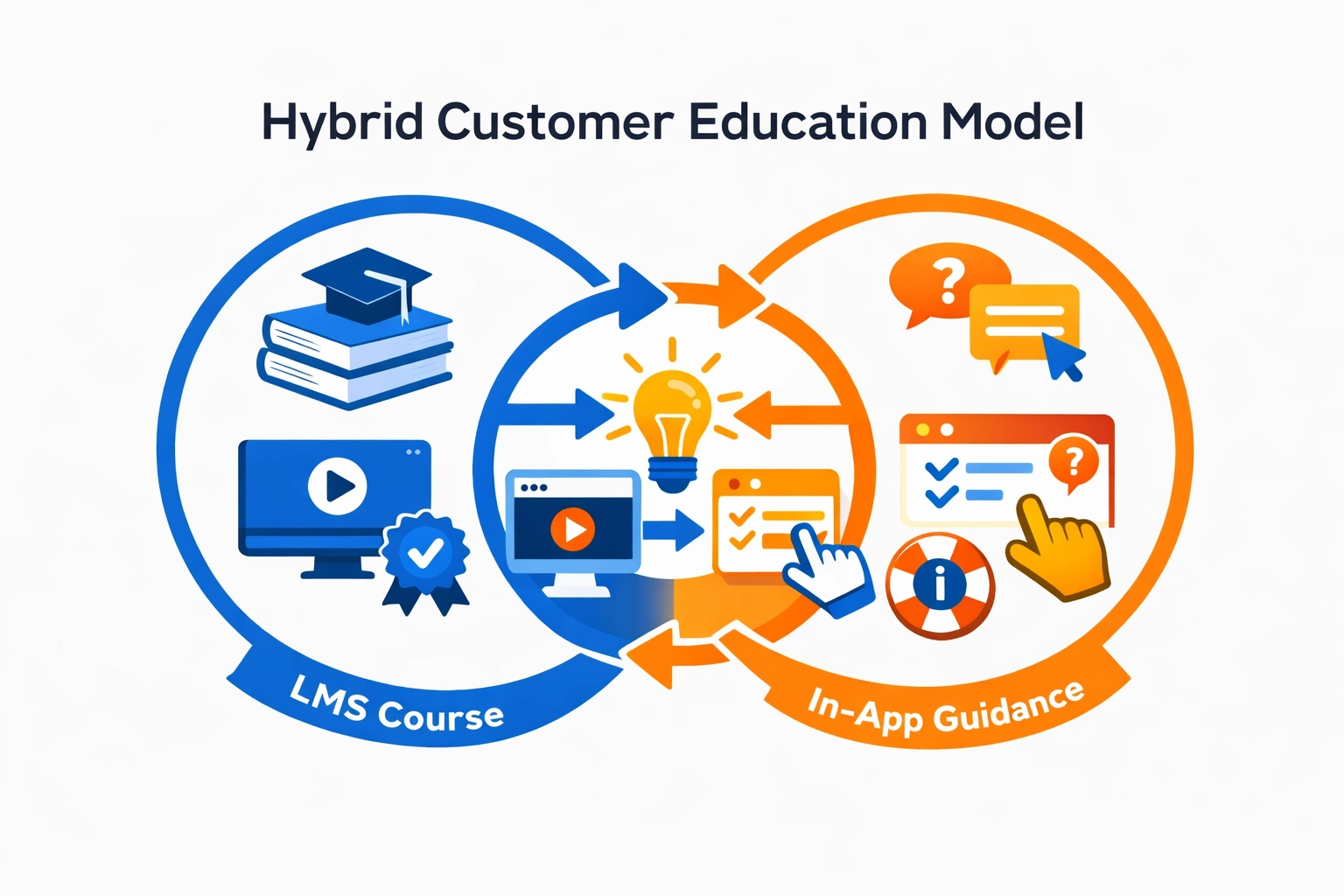
Don’t try to force everything into one model. A blended, intentional strategy always beats a one-size-fits-all approach.
The Future of Customer Education Is Invisible (And That’s a Good Thing)
Here’s where this is all heading: the best Customer Education will be invisible.
AI-powered, contextual, and hyper-personalized learning will anticipate what users need before they even know they need it. Your product will detect confusion, adapt guidance in real-time, and serve up the exact resource: whether that’s a 15-second tooltip or a deep-dive module: based on user behavior, role, and proficiency.
The line between “using the product” and “learning the product” will blur completely. And honestly? That’s exactly what your users want. They don’t want to learn your SaaS tool. They want to succeed with it.
Your job as a Customer Education leader is to make that success as frictionless as possible: whether that’s through a guided walkthrough, a certification path, or both.
Ready to build a hybrid customer education strategy that actually drives adoption? At Check N Click, we’ve spent 13+ years designing scalable training ecosystems for SaaS leaders who refuse to settle for “good enough.”
Let’s talk. We’ll show you what’s possible when learning gets out of the way, and lets users do what they came to do.