Navigating AI Governance in Custom eLearning Development can feel like trying to build a plane while it’s already flying, and everyone is watching. Let’s be real, the pressure to integrate Generative AI into your training modules is massive. Your competitors are doing it, your boss wants it done yesterday, and the “AI for Everything” hype train is full steam ahead.
But here’s the thing: while AI can slash development time and personalize learning like never before, jumping in without a governance safety net is a recipe for disaster. We’re talking about data leaks, biased training, and legal headaches that could make your HR team lose sleep.
We see you, trying to balance innovation with integrity. You want to use the latest tech without compromising your brand’s reputation. That’s why we’ve rounded up the seven biggest mistakes we see enterprises making right now. Let’s dive in before your next AI-generated module goes off the rails.
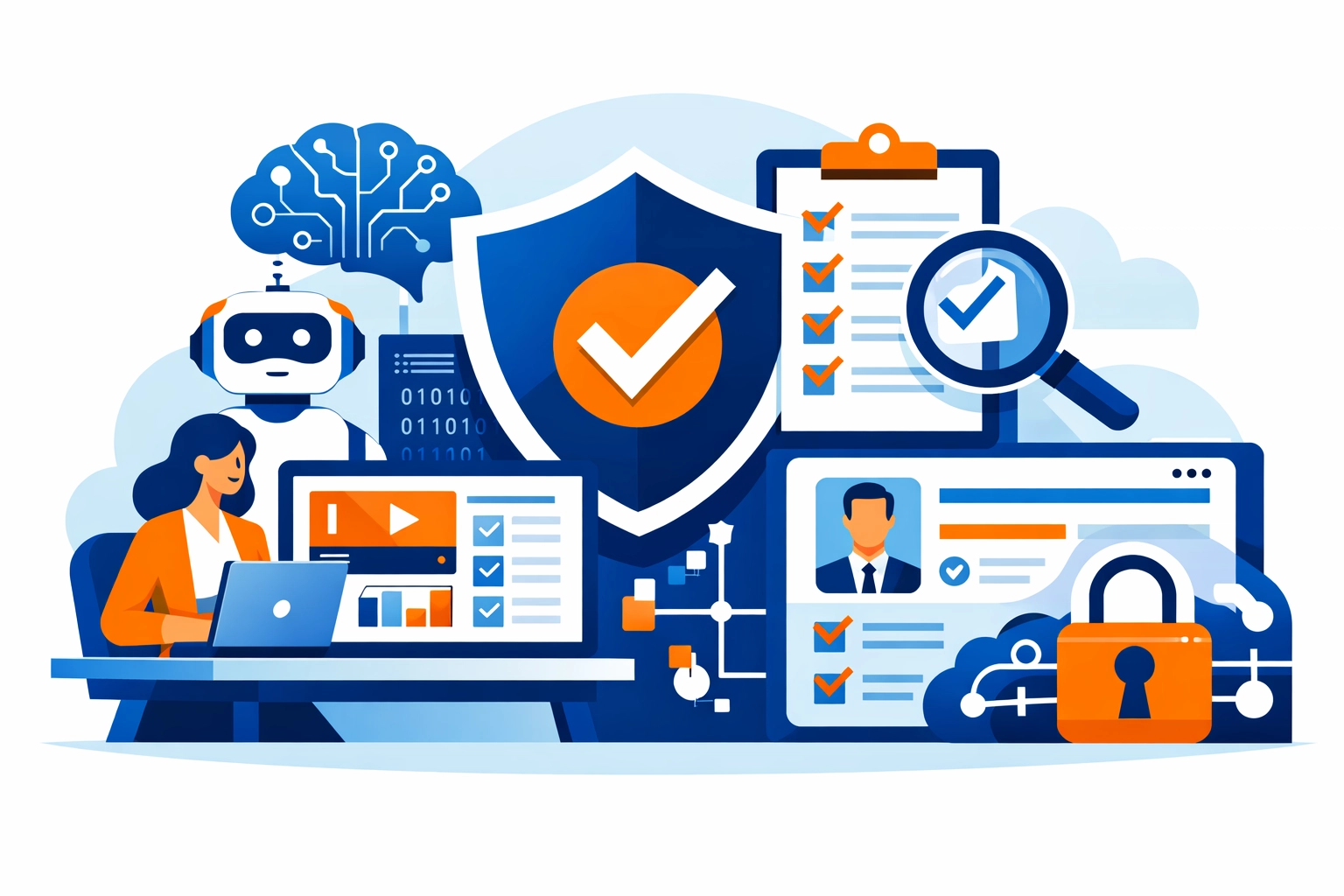
Why AI Governance in Custom eLearning Development Matters Now
Before we get into the “oops” moments, why are we even talking about governance? (Hello, endless Zoom meetings about policy!) It’s because AI isn’t just another software update; it’s a fundamental shift in how content is created and consumed. Without clear rules, you’re essentially flying blind in a very expensive, very public sky.
Governance isn’t just a buzzword to please the legal department; it’s about protecting your ROI. If your AI-generated content is inaccurate or breaches privacy, the cost of fixing it, and the damage to learner trust, far outweighs the initial time saved.
Alt text: A futuristic conceptual diagram showing the pillars of AI Governance in Custom eLearning Development for secure enterprise training.
1. The “Open Book” Policy Nobody Asked For: Data Privacy
Let’s face it, we’ve all been tempted to paste a chunk of proprietary company data into a public LLM like ChatGPT to “see what it comes up with.” But here is the reality: if you are using public AI tools without an enterprise agreement, you are effectively shouting your company secrets in a crowded coffee shop.
When you feed sensitive internal data into a public model to build custom modules, that data can be used to train future versions of the AI. (Yes, really!) Imagine your competitor asking an AI for “best practices in [Your Industry]” and getting a summary of your internal trade secrets.
Real talk: Don’t let your training data become public knowledge. Use private, secure enterprise instances where your data stays your data.
2. The IP Tug-of-War: Who Actually Owns the Content?
Here’s a fun question for your next legal lunch: who owns an eLearning module that was 90% generated by an AI? If you don’t have clear governance, the answer is… murky.
Most current copyright laws require “human authorship.” If your custom eLearning is purely a product of a machine, you might find yourself in a position where you can’t actually copyright your own training material. This becomes a massive headache if you ever want to license your content or protect it from being copied.
We get it, speed is important. But skipping the legal groundwork on Intellectual Property (IP) ownership can lead to a messy “who’s who” of content rights.
3. Perpetuating the Past: Bias and AI Governance in Custom eLearning Development
AI is like a mirror: it reflects whatever data it was fed during training. If that historical data contains biases (spoiler: it usually does), your AI-generated training will echo those biases right back to your learners.
In the context of AI Governance in Custom eLearning Development, this is a major red flag. Imagine a leadership training module that inadvertently excludes certain demographics because the AI “learned” that leaders in your industry historically look or act a specific way.
What’s the real impact? You risk alienating your workforce and failing your DEI (Diversity, Equity, and Inclusion) goals. You can’t just trust the machine to be “fair.” You need active audits to catch these biases before they reach the learner.

Alt text: A magnifying glass highlighting biased patterns in training data for AI Governance in Custom eLearning Development in enterprise learning.
4. The Human-Sized Hole: Lack of Oversight
“Let’s just let the AI write the quiz questions: what could go wrong?” (Famous last words, right?)
One of the biggest mistakes is assuming that because an AI is “smart,” it understands pedagogy. It doesn’t. AI is great at generating text, but it’s terrible at understanding the nuance of your specific business challenges or the emotional intelligence required for soft-skills training.
Relying on AI for instructional design without heavy Subject Matter Expert (SME) review is a shortcut to generic, uninspired, and sometimes flat-out wrong content. AI can provide the skeleton, but your SMEs provide the soul. Never skip the human-in-the-loop phase. Check out our case studies to see how we balance tech with human expertise.
5. Playing Hide and Seek: Lack of Transparency
Transparency isn’t just for skincare routines; it’s vital for learner trust. If a learner finds out later that the “expert” avatar they’ve been interacting with or the feedback they received was 100% AI-generated without being told, they feel cheated.
Let’s be real: people value human connection. When you use AI, own it. A simple disclaimer like “This module was developed with the assistance of AI and verified by our experts” goes a long way.
Hiding AI use makes it look like you’re cutting corners. Being transparent makes it look like you’re leveraging cutting-edge technology responsibly. Which vibe would you rather have?
Alt text: A digital transparency label on a custom eLearning course interface as part of AI Governance in Custom eLearning Development for enterprise teams.
6. Shackled to the Machine: Vendor Lock-in
We see you looking at those “all-in-one” AI eLearning platforms. They look shiny, right? But be careful. Many proprietary AI “black boxes” make it nearly impossible to move your content or data if you decide to switch vendors later.
If your entire training ecosystem is built on a specific vendor’s secret AI sauce, you are essentially at their mercy for pricing, updates, and data access. Effective governance involves ensuring you have a “way out.”
Focus on building a flexible stack that uses open standards. Don’t trade long-term agility for short-term convenience. You want to own your strategy, not be a tenant in someone else’s walled garden.
7. Ignoring the Rulebook: AI Governance in Custom eLearning Development & Compliance
Regulations aren’t just for the banking sector anymore. With the EU AI Act and tightening GDPR rules, how you use AI in training is now a matter of legal compliance.
If you are training global teams, you can’t afford to ignore these rules. Are you using AI to track learner emotions? That might be restricted. Are you using AI to make high-stakes decisions about employee certification? You better have a massive paper trail of human oversight.
Ignoring regulatory compliance isn’t just a “gold star” mistake; it’s a “legal fine” mistake. (And trust us, those fines aren’t small). Start by reviewing your privacy policy and ensuring your AI strategy aligns with global standards.
Moving Beyond the Mistakes: How to Get it Right
Let’s face it, AI is here to stay, and it is an incredible tool for custom eLearning development. But the difference between a high-performing training program and a governance nightmare lies in the details.
Don’t feel pressured to automate everything at once. Start with a clear policy, prioritize data security, and always: always: keep your humans in the loop.
Here’s the deal: If you’re feeling a bit overwhelmed by the complexity of AI Governance in Custom eLearning Development, you don’t have to go it alone. We’ve spent years helping enterprises navigate the shift from traditional training to tech-forward, ROI-driven education.

Alt text: A roadmap showing the steps to successful AI Governance in Custom eLearning Development for scalable enterprise training.
Why not see where you stand? Use our ROI calculator for training investment to see the potential impact of a well-governed program, or book some time with Lokesh to chat about your specific AI strategy.
Let’s build something that isn’t just fast, but smart, secure, and future-proof. You’ve got this!