Let’s be real, your customer training programs are probably costing you more customers than they’re helping.
Here’s the uncomfortable truth: 73% of SaaS companies report that poor customer training directly impacts churn rates, yet most teams keep making the same seven critical mistakes over and over. (Hello, endless support tickets and feature adoption that never takes off!)
After 13+ years of designing customer training programs for B2B SaaS companies, I’ve seen these patterns play out hundreds of times. The good news? These mistakes are fixable, and the companies that fix them see 2.3x higher product adoption and 40% lower churn rates.
Ready to transform your customer training programs from a cost center into a retention powerhouse? Let’s dive into the seven mistakes that are silently killing your customer success metrics.
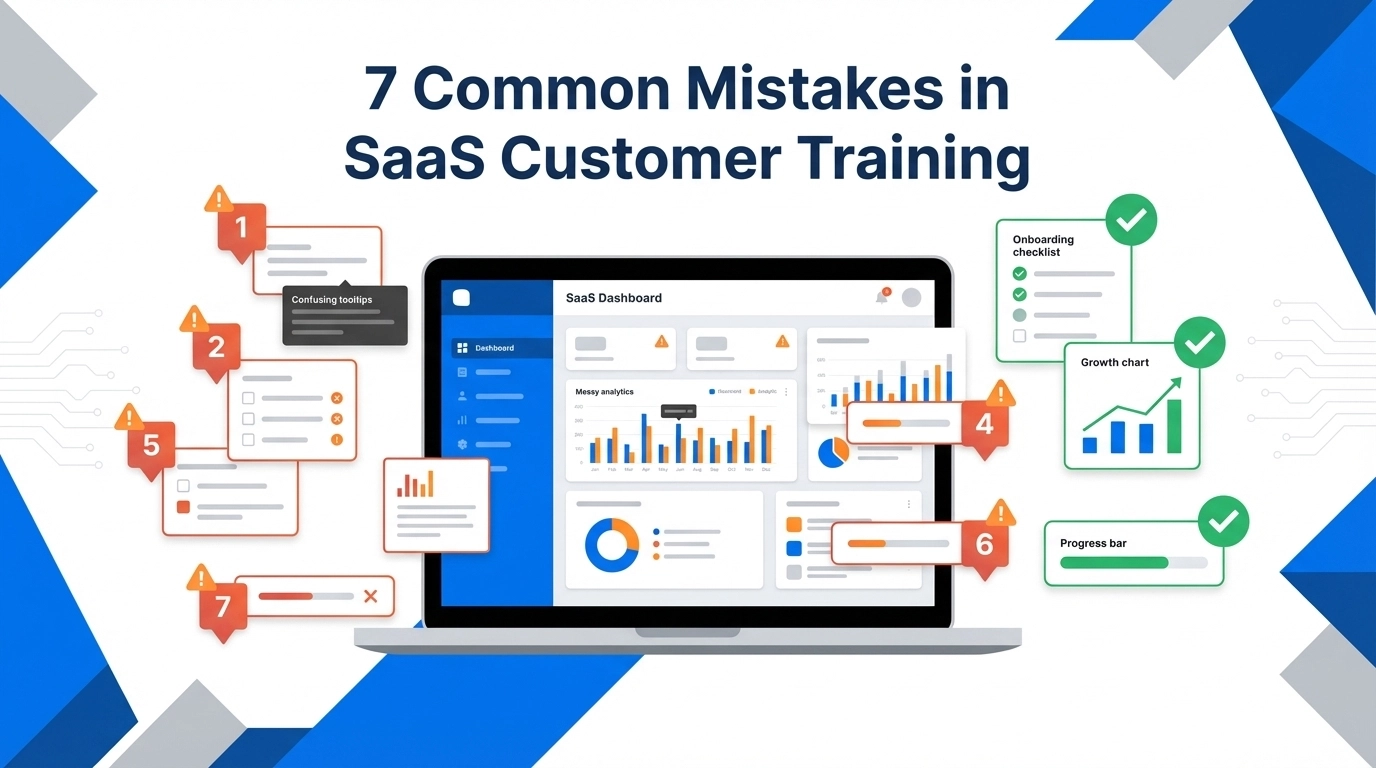
Mistake #1: Treating Onboarding as Your Only Training Window
The Problem: Most SaaS companies front-load everything into the first 30 days, then go radio silent. You create this massive information dump during onboarding, overwhelm new users, then wonder why feature adoption stagnates after month one.
The Real Impact: Users forget 90% of what they learned within a week. Your beautiful onboarding flow becomes a one-time event instead of an ongoing relationship.
The Fix: Design customer training programs with lifecycle-based learning paths. Create different training moments tied to user milestones, not just signup dates.
Actionable Example: Instead of cramming 15 features into week one, introduce advanced features when users hit specific usage thresholds. When someone creates their 10th project, that’s when you teach them about batch operations. When they add their 5th team member, introduce advanced permissions.
Slack nails this approach: they introduce new features based on team growth and usage patterns, not arbitrary timelines.
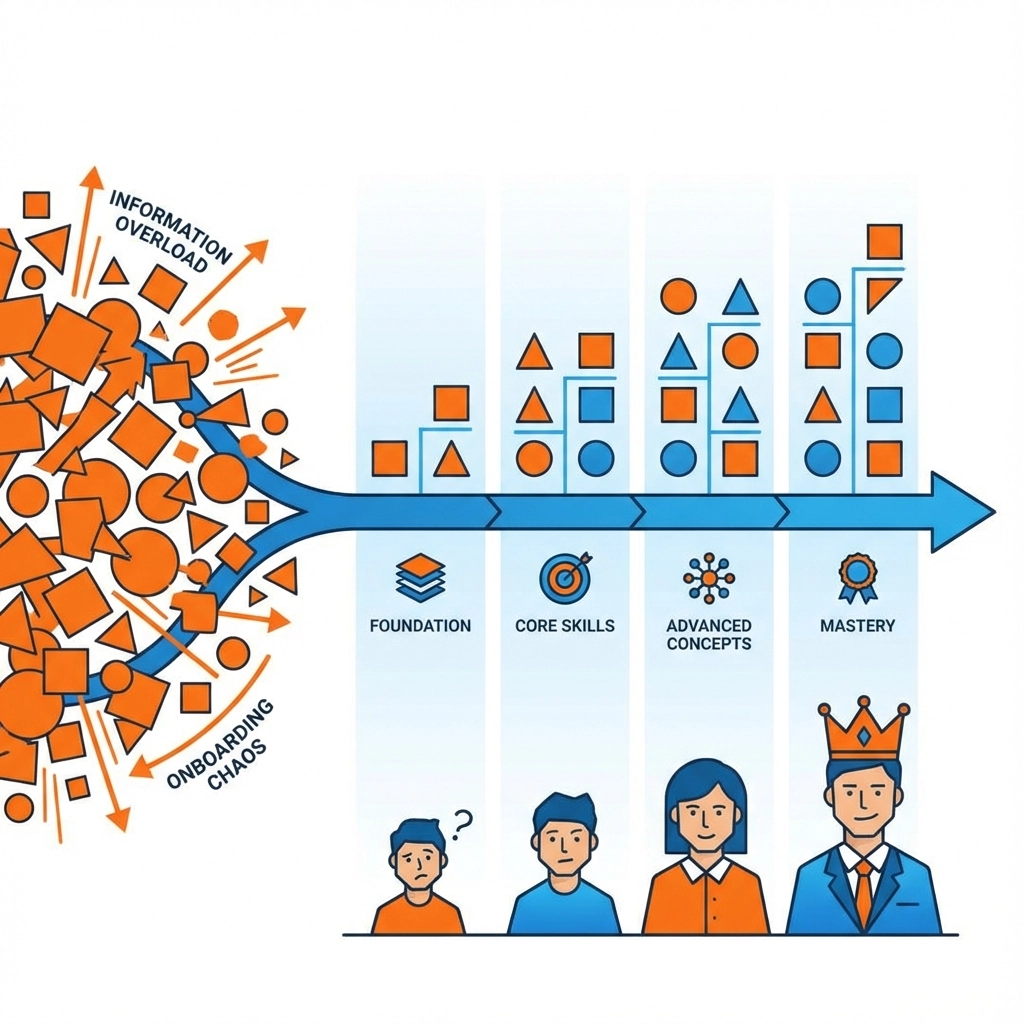
Mistake #2: Using One-Size-Fits-All Customer Training Programs
The Problem: You’re treating your CFO, your intern, and your power user the same way. Generic customer training programs ignore the fact that different roles need different information at different depths.
The Fix: Build persona-based learning tracks. Create role-specific pathways that speak directly to what each user type cares about.
Real-World Fix:
- Admins need security, integrations, and user management
- End users want quick wins and daily workflow optimization
- Decision makers care about ROI metrics and team productivity
HubSpot Academy does this brilliantly with separate tracks for marketers, salespeople, and customer service teams: each focusing on role-specific outcomes.
Mistake #3: Drowning Users in Passive Documentation
The Problem: Your training consists of PDF guides, lengthy videos, and static help articles. Users have to leave your product to learn how to use it better. (Think Netflix binge, but not in a good way.)
The Fix: Embed interactive learning directly into your product experience. Make learning contextual and actionable.
Implementation Strategy:
- Interactive product tours for new features
- In-app tooltips triggered by user behavior
- Progressive disclosure that reveals advanced features gradually
- Sandbox environments for safe experimentation
Success Story: Figma’s interactive onboarding lets users design while learning. They don’t explain design tools: they let you use them with guided practice. Result? 85% completion rate vs. industry average of 23%.
Want to calculate the ROI of interactive vs. passive training? Check out our training ROI calculator.
Mistake #4: Focusing on Features Instead of Outcomes
The Problem: Your customer training programs explain how buttons work, not why users should care. You’re teaching mechanics without meaning.
The Challenge: Users don’t buy your product to click buttons: they buy it to solve problems. Feature-focused training creates knowledgeable users who still don’t see value.
The Fix: Lead with outcomes, support with features. Structure every training module around a specific user goal.
Framework That Works:
- Start with the problem: “You need to reduce manual reporting time”
- Show the outcome: “Here’s how to cut 4 hours off your weekly reports”
- Teach the features: “Use automation rules and dashboard templates”
- Prove the value: “Sarah from TechCorp saved 16 hours last month”
Notion’s template gallery is a perfect example: they don’t teach database features in isolation; they show complete use cases like “Marketing Campaign Tracker” or “Product Roadmap.”

Mistake #5: Ignoring the Power of Microlearning
The Problem: Your training sessions are hour-long marathons that nobody finishes. You’re asking busy professionals to block out significant time for learning, which rarely happens.
The Reality Check: The average knowledge worker has 24 minutes of uninterrupted time per day. Your 45-minute training modules are dead on arrival.
The Fix: Break complex topics into 3-5 minute microlearning modules that deliver immediate value.
Microlearning That Works:
- Quick Wins: “How to create a custom filter in 2 minutes”
- Problem Solvers: “Fixing the 3 most common sync errors”
- Power Tips: “Hidden shortcut that saves 30 seconds per task”
- Update Alerts: “New feature spotlight: What changed and why you care”
Pro Tip: Use progressive disclosure. Master basic concepts before introducing advanced ones. Each micromodule should build on the previous one while delivering standalone value.
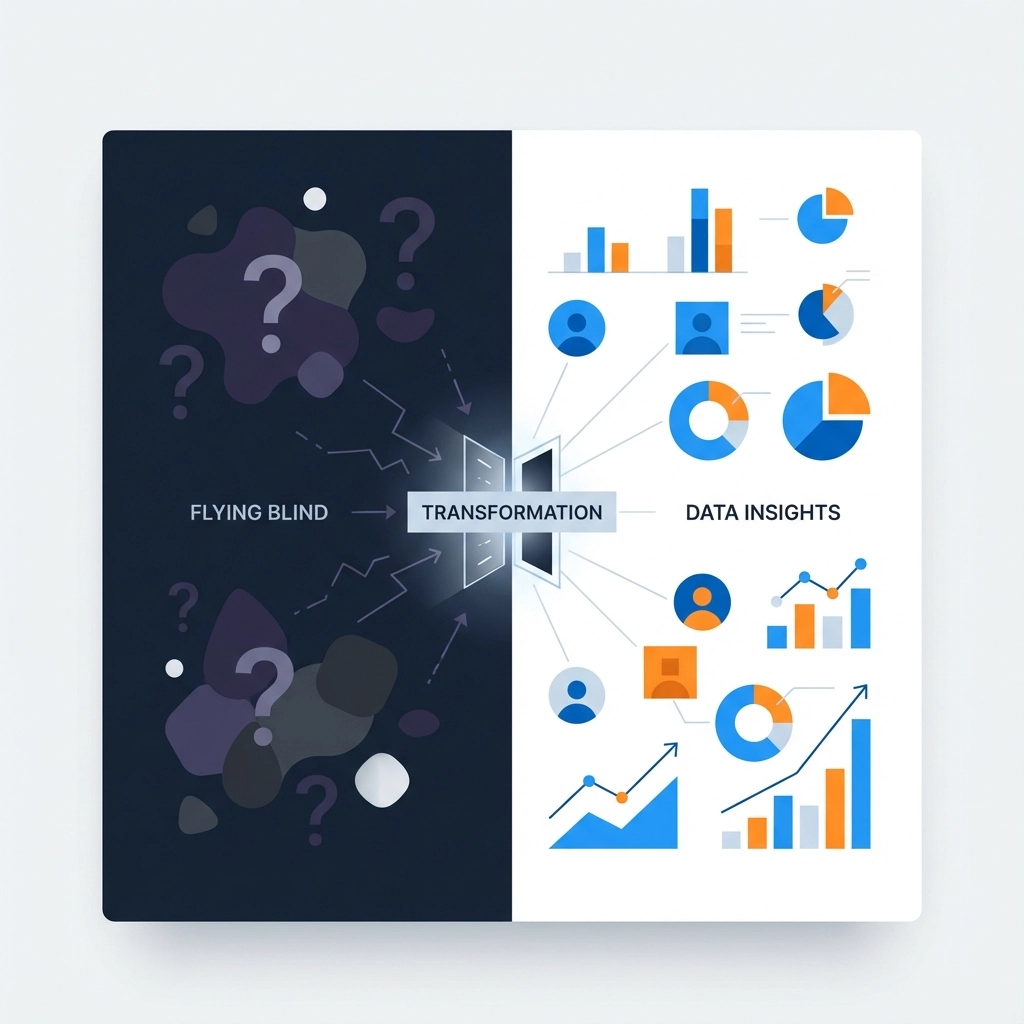
Mistake #6: Flying Blind Without Analytics for Customer Training Programs
The Problem: You have no idea which parts of your customer training programs actually work. You’re making decisions based on gut feeling instead of data.
What You’re Missing:
- Which training modules correlate with higher feature adoption?
- Where do users drop off in your learning paths?
- What training content predicts lower churn?
- Which user segments need different approaches?
The Fix: Implement training analytics that connect learning to business outcomes.
Key Metrics to Track:
- Completion rates by module and user type
- Time-to-competency for different features
- Feature adoption post-training vs. pre-training
- Support ticket reduction for users who complete specific modules
- Churn correlation with training engagement
Success Framework: Companies using data-driven training optimization see 3.2x better completion rates and 45% higher feature adoption. The secret? They continuously optimize based on what actually drives results, not what they think should work.
Ready to implement analytics-driven customer training programs? Book a strategy session with our team.
Mistake #7: Creating Training in a Content Vacuum
The Problem: Your training team works in isolation from customer success, support, and product teams. The result? Training that doesn’t address real user pain points or current product realities.
The Disconnect: Support sees the same questions 50 times a day, but training doesn’t cover those topics. Product ships new features, but training lags weeks behind. Customer success knows exactly where users struggle, but that insight never reaches training content.
The Fix: Create cross-functional training development with regular feedback loops.
Integration Strategy:
- Monthly sync with support to identify top training gaps
- Product release alignment to ensure day-one training readiness
- Customer success feedback on real-world usage patterns
- User interview insights directly inform content priorities
Real Example: Zendesk’s training team meets weekly with support to review ticket trends. When they noticed a spike in “automation setup” tickets, they created a targeted training series that reduced those tickets by 60% within two months.
Your Customer Training Decision Framework
Before you overhaul everything, ask yourself these strategic questions:
Assessment Questions:
- Outcome Focus: Does each training module clearly connect to a business outcome users care about?
- Accessibility: Can users complete training without leaving their workflow?
- Personalization: Do different user types get relevant, role-specific content?
- Measurement: Can you prove which training directly improves retention and adoption?
- Timing: Does training happen when users need it, not when it’s convenient for you?
Quick Audit: Review your last 10 support tickets. How many issues could have been prevented with better-targeted customer training programs? If the answer is more than 3, you have a training problem, not a support problem.
Transform Your Customer Training Programs Today
Here’s the thing: fixing these seven mistakes isn’t just about better training. It’s about turning customer education into your most powerful retention and expansion tool.
Companies that get customer training programs right see:
- 67% higher feature adoption rates
- 40% reduction in support ticket volume
- 2.3x better customer lifetime value
- 45% lower churn in the first year
Ready to get started? Don’t try to fix everything at once. Pick the mistake that’s costing you the most customers right now and focus there.
Need help prioritizing? Use our ROI calculator to see which training improvements will deliver the biggest impact for your business.
Want to see real results? Check out our case studies showing how SaaS companies reduced churn by 40%+ through strategic customer training programs.
Ready to discuss your specific situation? Book a free strategy session, and we’ll audit your current approach and identify your biggest opportunities.
Your customers want to succeed with your product. Give them customer training programs that actually help them get there.