In customer education, implementing AI in enterprise learning shouldn’t feel like a high-stakes game of hide-and-seek with your own department’s data. But here’s the reality: it’s happening right now, under the radar, in what we call “Shadow AI.”
Let’s be real for a second. You’ve probably seen the headlines about AI replacing jobs or writing Shakespearean sonnets, but the real story in L&D is much quieter and much riskier. It’s the sound of a thousand “Copy/Paste” commands into unvetted browser tabs. It’s the “Quiet” AI adoption that is currently the biggest threat to your organizational integrity.
Is your team using AI to speed up content creation? (Of course they are!) But do you actually have a seat at the table when it comes to how that technology is governed?
![[HERO] Shadow AI Risks in Enterprise & Customer Education](https://cdn.marblism.com/ZTzKC07uQ-3.webp "[HERO] Shadow AI Risks in Enterprise & Customer Education")
What exactly is Shadow AI in enterprise learning?
Here’s the deal: Shadow AI is the unauthorized use of artificial intelligence tools by employees without the approval, visibility, or oversight of IT and security teams. Think of it like the “Shadow IT” of the early 2000s, when everyone started using Dropbox because the company file share was too slow, but on steroids.
In the rush to be “efficient,” L&D teams are grabbing every shiny new tool they can find. According to recent data, a staggering 87% of training teams are already using AI to speed up content creation. That sounds great for productivity, right?
Here’s the kicker: 42% of those organizations have no strategic owner for AI use and governance.
When you have nearly 90% of a workforce using a tool that almost half the companies aren’t even tracking, you don’t have a “strategy”, you have automated chaos. We’re seeing teams use unvetted tools without a roadmap, and while it might save an hour of writing time today, it’s building a governance nightmare for tomorrow.
The Hidden Dangers of AI in Enterprise Learning & Customer Education
Why does this matter? Why shouldn’t we just let the instructional designers use whatever tool helps them get the job done? (We see you, trying to hit those impossible deadlines!)
The truth is, efficiency without governance is a trap. Here are the three primary risks that are likely keeping your C-suite up at night, or at least, they should be.
1. Data Privacy: Is your IP fueling public LLMs?
Let’s talk about the biggest elephant in the room: Data Privacy. When an instructional designer inputs a sensitive company SOP, a proprietary product roadmap, or customer education enablement content into a public, free-tier Large Language Model (LLM) to “summarize” it, that data is often no longer yours.
Many public AI systems log, retain, and use your prompts to train their future models. This means your sensitive company IP (including customer education assets like product walkthroughs, onboarding flows, and support playbooks) is effectively being fed into the public domain. Once that data leaves the enterprise boundary, it’s gone. (Think of it as giving your secret sauce recipe to a chef who then puts it on every menu in town.)
At Check N Click, we’ve seen how even Fortune 500s struggle with this. Without a secure, enterprise-grade privacy policy and vetted tools, you are essentially leaking your competitive advantage one prompt at a time.
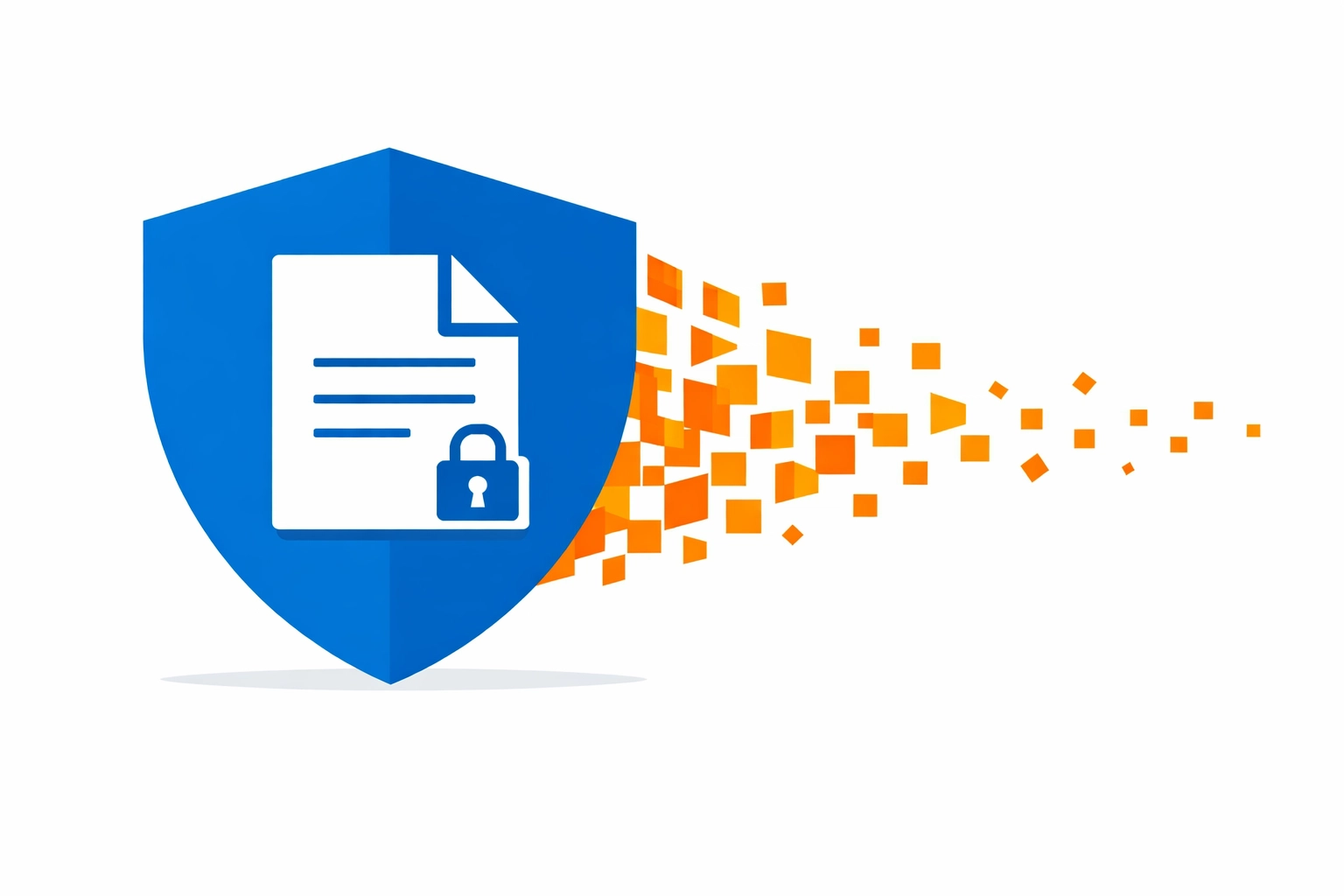
Alt text: A digital security lock representing data privacy for customer education and AI in enterprise learning.
2. Brand Dilution: When AI ignores your identity
Have you ever looked at a piece of content and thought, “This just doesn’t feel like us”?
That’s brand dilution. When teams use a dozen different unvetted AI tools, they aren’t just generating text; they are generating a “vibe” that might be completely disconnected from your corporate identity.
- UI Drift: Different tools generate different styles of buttons, layouts, and interactions that don’t match your LMS theme.
- Voice Inconsistency: One module sounds like a formal professor, while the next sounds like a caffeinated teenager.
- Visual Chaos: AI-generated images that vary wildly in quality and style, making your professional training look like a high school collage project.
Maintaining a cohesive brand is hard enough when humans are doing the work. When you add “Shadow AI” into the mix, your learners (including the people in customer education who judge you by your tutorials) end up in a disjointed experience that erodes trust in the training itself.
3. The ROI Trap: Speed vs. Performance
Here’s a “real talk” moment: Content is faster to make than ever before, but is it actually driving performance?
In the L&D world, we often fall into the trap of measuring success by “volume” or “speed to market.” But if you produce 100 courses that nobody completes (or a customer education series that sends users down the wrong click-path), or worse, courses that provide inaccurate information because the AI “hallucinated” a fact, your ROI is zero. Actually, it’s negative, because you’ve wasted learner time.
If you aren’t sure where your current training stands, check out our ROI calculator for training investment. It helps to ground these AI dreams in actual business reality. Don’t try to automate a broken process; all you’ll get is more “broken” at a higher velocity.
Strategies for Governing AI in Enterprise Learning & Customer Education
So, how do we fix this? Do we ban AI? (Spoiler: No, that never works.) Instead, we need to move from “Shadow AI” to “Strategic AI.”
Here is how you can start building a framework that turns AI into an asset rather than a liability.
Step 1: Centralize Ownership (including customer education)
Someone needs to own the AI roadmap. Whether it’s the Head of L&D, a dedicated “Learning Technologist,” or a cross-functional committee, there must be a seat at the table for AI governance. This person or group is responsible for vetting tools, setting usage guidelines, and ensuring compliance with IT security standards.
Step 2: Build a “Safe Sandbox”
Don’t just tell people “no.” Give them a “yes” that is safe. Provide your team with access to enterprise versions of AI tools (like ChatGPT Enterprise or Microsoft Copilot) where data is not used for training and remains within your corporate walls. This satisfies the need for speed while protecting your IP.
Step 3: Align with Instructional Design Foundations
AI is a tool, not a strategy. It should be used to enhance proven models, not replace them. For instance, you can use AI to help map content to Gagne’s Nine Events of Instruction or to speed up the iterative loops in the SAM model.
When you anchor AI in established instructional design frameworks, you ensure that the speed of creation doesn’t outrun the quality of the learning.

Alt text: An instructional design framework illustrating customer education and the integration of AI in enterprise learning.
Step 4: Audit Your Current “Content Graveyard” (and customer education library)
Before you go creating new AI content, look at what you already have. Many platforms suffer from “content decay.” If you feed outdated or poor-quality content into an AI to create a new course (or refresh customer education FAQs and onboarding modules), you’re just recycling garbage.
Take a look at our guide on LMS content hygiene to clean up your current library first. AI works best when it has high-quality “source truth” to pull from.
Why Experience Matters in the Age of AI (and customer education)
Let’s face it, anyone can open an AI tool and prompt it to “write a course on leadership.” But making that course effective, brand-compliant, and technically sound within a complex LMS environment? That takes experience.
At Check N Click, we don’t just build content; we build the strategic frameworks that make AI in enterprise learning work (especially when customer education is on the line). With over 20 years in the eLearning industry and 13+ years leading custom development, we’ve seen technology cycles come and go. We know that while the tools change, the need for strategic governance never does.
Whether you are looking to outsource eLearning services or need a deep dive into custom eLearning development, we focus on the “human-in-the-loop” strategy. We ensure that AI serves the learner, not the other way around.
The Bottom Line: Get a Seat at the Table
Shadow AI is a symptom of a workforce that wants to be better and faster. That’s a good thing! (Gold stars for everyone!) But without a roadmap, that enthusiasm can lead to data leaks and brand disasters—across internal training and customer education.
Why does this matter right now? Because the window for setting governance is closing. Once your team has built an entire library of “unvetted” content, it’s ten times harder to go back and fix it.
Here’s your call to action: Start the conversation today. Ask your team what tools they are using. Don’t be the “AI police”: be the “AI partner.” Help them understand the risks of data privacy and brand dilution, and provide them with the secure tools they need to succeed.
Ready to move from “automated chaos” to a world-class AI strategy? We’ve helped organizations navigate these waters for over a decade. From mastering customer education to building complex technical training, we understand the nuances of governance.

Alt text: Two professionals discussing strategic governance for customer education and AI in enterprise learning.
Let’s talk governance. Is your team using AI under the radar, or do you have a unified strategy?
If you’re feeling overwhelmed by the “Shadow,” don’t worry: you don’t have to navigate this alone. You can always book time with Lokesh to discuss how to build a custom AI framework that protects your IP and boosts your ROI.
Let’s make AI an asset, not a liability. (And maybe keep those secret recipes actually secret!)