Tired of being a training order taker? Master customer education and custom eLearning development to become the trusted advisor who drives real business results!
Sam is a seasoned Instructional Designer at a B2B SaaS company (the kind where “customer education academy” gets said with a straight face in every leadership meeting). He was hired to lead a world-class customer education academy and was promised a seat at the strategy table. You know, roadmap visibility, proactive enablement, the whole “trusted advisor” vibe.
Then, week one happened.
He’s barely figured out where the templates live when the Head of Support corners him (politely, but with the energy of someone holding a metaphorical fire extinguisher) and says: “Hey, we need something urgent. Can you create a 40-page technical manual for this legacy feature?”
Plot twist: that feature is being sunsetted next month.
And just like that, Sam isn’t being asked to shape strategy or solve a customer adoption problem. He’s being asked to produce a deliverable. Fast. No discovery. No audience analysis. No “what’s the business impact?” conversation. Just: make the thing.
Let’s be real: we’ve all been Sam.
That’s the order-taker vs. trusted-advisor conflict in a nutshell. Order takers get deadlines and page counts. Trusted advisors get context, outcomes, and the space to recommend what actually moves the needle in customer education. (And yes, sometimes the best “training” is not a 40-page manual that expires in 30 days.)
If you’re nodding your head right now, you’re not alone. This is the classic struggle in the L&D and educational technology world. We want to be trusted advisors, but the organization treats us like order takers. But here’s the thing: if we want that to change, we have to be the ones to change it.
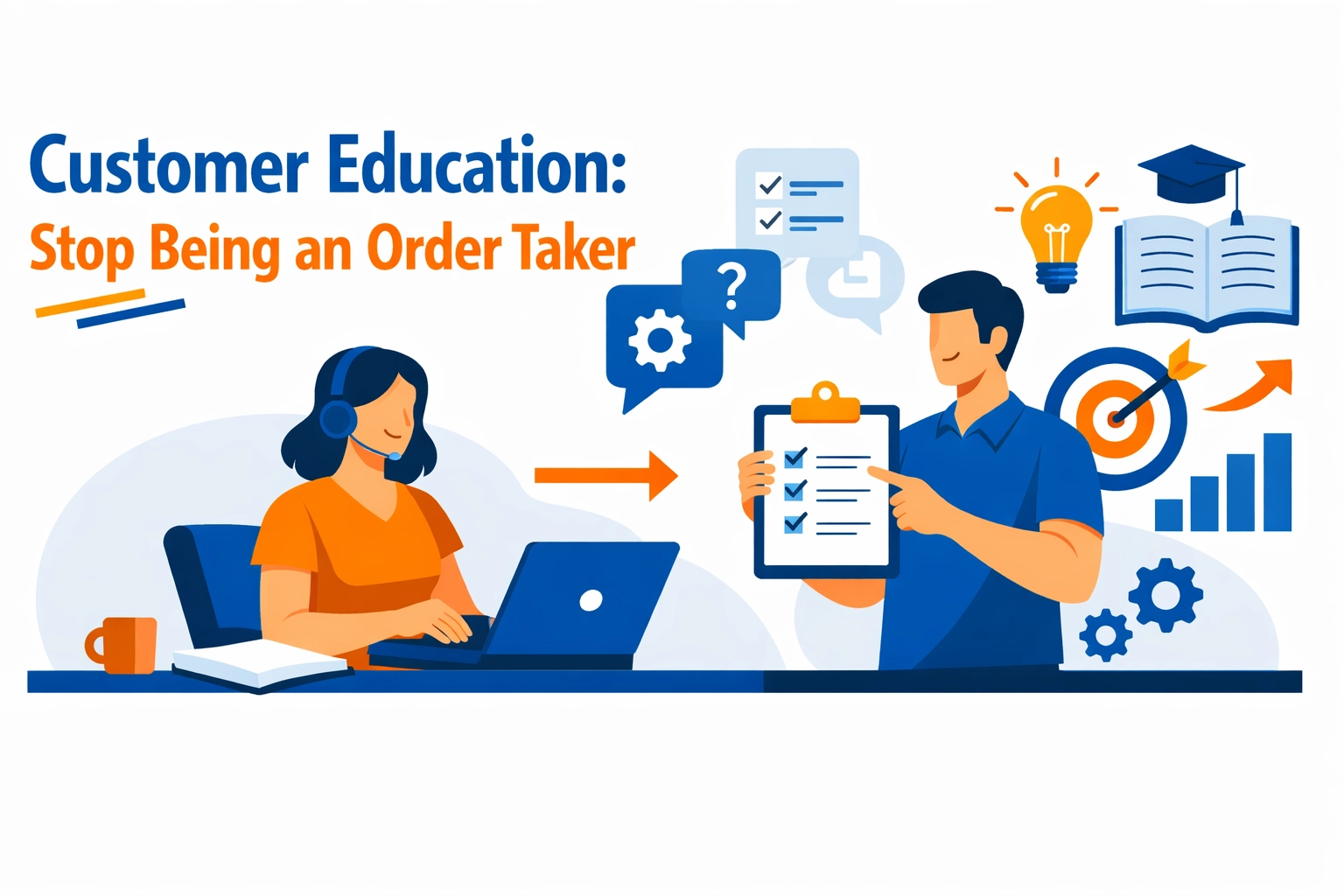
Why Customer Education and Custom eLearning Development Needs Advisors, Not Order Takers
Here’s the deal: when L&D is relegated to a reactive role, the company loses money. It’s that simple. When we just “take orders,” we end up solving the wrong problems with expensive solutions.
Historically, career development and training were top-down. In the early 20th century, it was all about production line efficiency, making people work faster, not smarter. But today? The nature of work has flipped. We know from motivational psychology that when customer education is proactive and strategic, it drives product adoption, reduces churn, and turns users into advocates.
Yet, many companies still see employee or customer development as a “painful expense.” They only call the experts when a fire is already burning.
So, what is a “trusted learning advisor”?
Think of them as the proactive leaders of the L&D world. They don’t just ask “When do you need this by?” They ask, “Why are we doing this in the first place?” They are consultative, strategic, and collaborative. They don’t just build courses; they solve business problems.

Alt text: customer education and custom eLearning development strategic planning session
The Danger of the “Order Taker” Mentality in Customer Education
Let’s talk about a scenario we see all the time in custom eLearning development.
Imagine the CFO of a retail chain comes to you. They are frustrated because the sales teams aren’t using the CRM system correctly. The data is a mess, and financial predictions are impossible. The CFO’s solution? “They need a refresher course on the CRM. Build me three modules by next month.”
As an order taker, you say “Yes, sir!” and get to work. You spend weeks building beautiful, interactive modules. You track completion rates. You get 100% compliance! (Gold stars all around, right?)
But two months later, the data is still a mess. Why? Because you didn’t look under the hood.
If you had acted as a trusted advisor, you would have interviewed the sales team first. You might have discovered they know the CRM perfectly well; they just aren’t motivated to use it because it takes 30 minutes away from their sales floor time, and they don’t get a commission for data entry.
In this case, more training was a waste of everyone’s time. The real solution might have been to change KPIs or simplify the data entry process. But because you just “took the order,” you provided a solution for a problem that didn’t exist. We’ve all been there, and it’s a total buzzkill for your ROI calculations.
Building Trust in Your Custom eLearning Development Strategy
Moving from an order taker to an advisor isn’t something that happens overnight. It requires a fundamental shift in how you build relationships. Expertise alone isn’t enough; you need trust.
Trust is easy to break and tough to build, but it is the number one predictor of your success. To get a seat at the decision-making table, you need to lean into the five pillars of trust:
- Credibility: This is your “street cred.” Do you know your stuff? Are you staying up to date on instructional design trends?
- Reliability: Do you do what you say you’re going to do? Stakeholders trust people who meet deadlines and follow through.
- Professional Intimacy: This sounds fancy, but it just means understanding your stakeholders’ fears and motivations. What keeps the VP of Sales up at night? (Hint: It’s usually not “module engagement scores”).
- Intention: Does the stakeholder believe you have their best interests at heart, or are you just trying to protect your own department’s budget?
- Communication: Are you listening more than you’re talking? Try the 70/20/10 rule: spend 70% of your time listening, 20% asking clarifying questions, and only 10% summarizing and giving advice.
By combining these pillars, you move from being a “vendor” to being a “partner.” This is exactly what we focus on at Check N Click when we handle custom eLearning development projects.

Alt text: customer education, five pillars of trust for success
Transforming Customer Education via the IDAD Process
So, how do you actually handle a request when it comes in? You don’t just say “No” (that’s a great way to get excluded from future meetings). Instead, you use the IDAD Process: Intake, Discovery, Analysis, and Decision.
1. Intake
When the “order” comes in, listen attentively. Don’t push back immediately. Your goal here is to formulate a clear problem statement. What is the stakeholder actually trying to achieve?
2. Discovery
This is where the real work happens. Conduct interviews, run surveys, and look at the data. If this is a customer education issue, talk to the customers! Find the root cause, not just the symptom. (Is the software hard to use, or is the documentation just buried in a PDF?)
3. Analysis
Scrutinize the information you gathered. Does the data support the stakeholder’s original request for a training course? This is where you develop your evidence-based recommendations. You can check out our case studies to see how deep analysis changes the final product.
4. Decision
Present your findings. This isn’t you telling them what to do; it’s a collaborative review. You are showing them the path that leads to the best business results.
Overcoming the “No”
“But Penny,” you might say, “What if I do all that and they still just want the 60-slide PowerPoint converted to SCORM?”
Resistance is part of the process. When a stakeholder says no to your strategic advice, don’t take it personally. Here are three quick strategies to pivot:
- “Not Right Now”: Sometimes the stakeholder is just overwhelmed. Ask: “What would need to change for you to feel comfortable trying this approach next quarter?”
- Bring in Reinforcements: Use data or perspectives from other departments. Sometimes a “no” to L&D becomes a “yes” when the Support team says the current training is increasing ticket volume.
- Start Small: Don’t try to boil the ocean. Propose a “Minimum Viable Product” (MVP) or a pilot program. It’s a lot harder to say no to a small experiment than to a total strategy overhaul.

Alt text: customer education and custom eLearning development prototype and feedback loop
The Path Forward: From Order Taker to Strategic Partner
At the end of the day, transforming your role in customer education is about embracing a new professional identity. It’s about having the curiosity to ask “Why?”, the critical thinking to analyze the data, and the empathy to understand your stakeholders’ pressure points.
When you stop taking orders and start providing solutions, you don’t just make better courses: you drive real, measurable change for your organization. You move from being a cost center to being a profit center. (And let’s be real, that feels a lot better than just checking boxes).
Ready to stop being an order taker and start building high-impact learning? Whether you are looking for instructional design services or a complete strategy overhaul, we’re here to help.
Here’s the reality: Your expertise is too valuable to be wasted on “urgent” fires that don’t move the needle. It’s time to take your seat at the table.
Need a hand navigating your next project? Book time with Lokesh to discuss how we can turn your training into a strategic powerhouse. Let’s get to work!