Customer Success and Customer Education convergence isn’t just a buzzword anymore; it’s the difference between companies that retain customers and those that watch their churn rates climb. Let’s be real: if your CS and CE teams are still operating in silos in 2026, you’re leaving serious revenue on the table. And yes—Customer Success and Customer Education convergence is measurable when you tie training to the same revenue metrics CS already lives and dies by.
Here’s the thing. Your Customer Success team is firefighting all day, managing escalations, monitoring health scores, and trying to prevent churn. Meanwhile, your Customer Education team is cranking out courses, tracking completion rates, and wondering why nobody seems to care about their beautiful learning paths. Sound familiar?
The truth is, education IS success now. Not a nice-to-have. Not a support deflection tool. It’s the foundation of product adoption, expansion, and retention. And the companies winning in the extended enterprise space? They’ve figured out how to make CS and CE speak the same language: revenue.
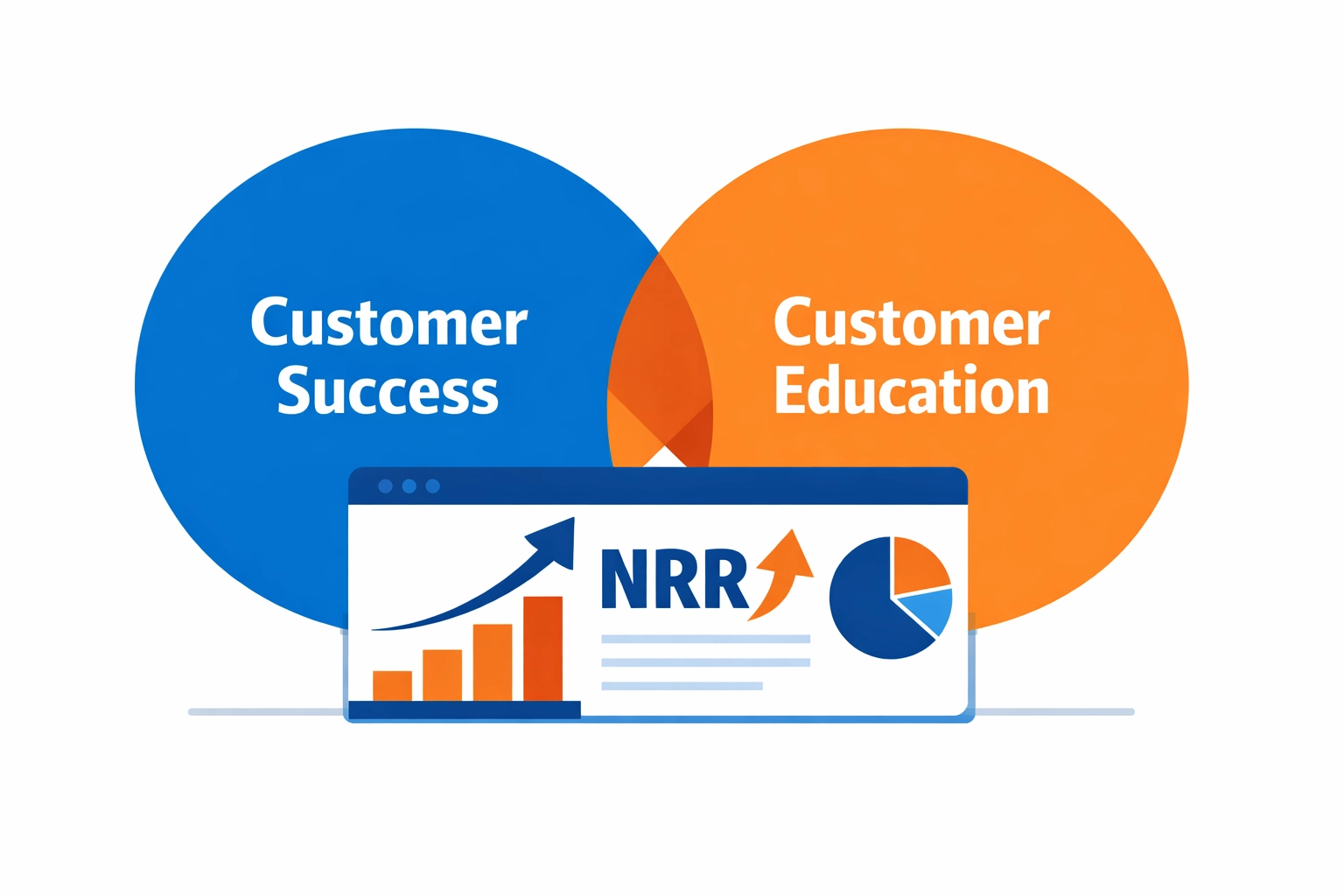
The Shift: From Vanity Metrics to Net Revenue Retention
For too long, CE teams have celebrated course completions like gold stars (cute, but meaningless). CS teams tracked support tickets closed (also cute, also not telling the full story). But here’s what actually matters to your CFO: Net Revenue Retention (NRR).

NRR measures the revenue you keep and expand from existing customers after accounting for churn and downgrades. It’s the metric that shows whether your customer base is growing in value or bleeding out. And guess what? Nearly 80% of organizations are now seeing a direct correlation between customer training and product onboarding success, which directly impacts NRR—exactly why Customer Success and Customer Education convergence belongs on the revenue dashboard, not in a “nice-to-have” corner.
When CS and CE teams align on shared revenue metrics rather than department-specific KPIs, magic happens. Suddenly, you’re not just delivering training for the sake of training. You’re building learning experiences that move the needle on renewal rates, expansion revenue, and customer lifetime value—which is the whole point of Customer Success and Customer Education convergence.
Don’t feel pressured to overhaul everything overnight. Start by identifying which metrics both teams can influence together. Then build from there.
Metric 1: Time-to-Value (TTV) in Customer Success and Customer Education Convergence
Let’s talk about Time-to-Value. This is the time it takes for a new customer to experience their first meaningful outcome with your product. The faster they get there, the stickier they become.
Here’s where rapid instructional design methodologies like SAM (Successive Approximation Model) become your secret weapon. Unlike traditional ADDIE approaches that can take months, SAM helps you build iterative, feedback-driven training that gets customers productive fast.
Think about it: Would you rather spend three months perfecting a 10-module certification program that launches when half your new customers have already churned? Or would you rather ship a lean onboarding sprint in three weeks, measure adoption, and iterate based on real usage data?
The second option speeds up TTV. And when customers see value quickly, they stick around. They expand. They become advocates.
What to track:
- Days from contract signature to first successful use case
- Percentage of users completing foundational training within first week
- Correlation between rapid onboarding completion and 90-day retention
At Check N Click, we’ve built learning ecosystems using SAM methodology that cut TTV by 40% for enterprise SaaS clients—proof that Customer Success and Customer Education convergence can be operationalized fast. Because in 2026, slow onboarding is a growth killer.
Metric 2: Feature Adoption in Customer Success and Customer Education convergence
Here’s a stat that should get your revenue team’s attention: educated users are 3x more likely to upgrade to higher-tier plans or adopt additional features.
Why? Because they actually understand what they already have. Most users are sitting on features they paid for but never discovered (hello, endless unused dashboards). When you proactively educate customers about advanced features, use cases, and integrations, you’re not just reducing underutilization; you’re creating opportunities for expansion.
This is where the Customer Success and Customer Education convergence becomes a revenue engine. Your CS team knows which accounts have expansion potential. Your CE team knows how to design learning paths that drive feature discovery and adoption. Put them together, and you’ve got a playbook for predictable upsells.
What to track:
- Feature adoption rates by customer segment
- Time from feature release to 25% adoption
- Correlation between advanced training completion and account expansion
- Average contract value (ACV) lift for trained vs. untrained users
But here’s the good news: You don’t need to build a university. Start with targeted micro-learning for your top 3 underutilized features. Use in-app guidance, short videos, and contextual help. Then measure whether trained users activate those features and whether activation correlates with renewals and expansions.
We see this pattern constantly: Companies that connect education to feature adoption see their expansion revenue grow 25-30% year-over-year. That’s not coincidence: that’s strategic customer education design.
Metric 3: Churn Reduction Through Customer Success and Customer Education Convergence
Let’s face it: churn is expensive. Acquiring a new customer costs 5-7x more than retaining an existing one. So what if I told you that customers who complete certification programs churn at rates 40-60% lower than those who don’t?
Certifications aren’t just badges and bragging rights. They’re commitment devices. When someone invests time in becoming certified in your product, they’ve mentally committed to using it long-term. They’ve built expertise. They’ve connected their professional identity to your platform.

That’s powerful retention psychology.
But here’s the reality: Not every certification program drives loyalty. Badly designed certifications (think: 47 slide decks and a boring multiple-choice quiz) won’t move the needle. You need learning experiences that feel valuable, relevant, and worth the investment.
What to track:
- Customer Retention Rate (CRR) for certified vs. non-certified users
- Churn rate by training engagement level
- Time between last learning activity and renewal decision
- Percentage of power users who’ve completed advanced training
At Check N Click, we’ve spent 13+ years designing certification programs that people actually want to complete. We use Gagné’s Nine Events of Instruction to build scaffolded learning experiences that feel like skill-building, not homework. And we track how those programs impact not just completion rates, but renewal rates and Net Promoter Scores—because Customer Success and Customer Education convergence should show up in retention data, not just LMS reports.
Because a certification program that doesn’t reduce churn is just expensive content creation.
The Check N Click Advantage: 13+ Years of Revenue-Focused Learning Design
Here’s what we’ve learned after more than a decade building custom eLearning solutions for Fortune 500 companies, SaaS scale-ups, and extended enterprise teams: Customer Success and Customer Education convergence only works when the learning strategy is tied to revenue outcomes (not just completions).
Education that drives revenue is different. It’s not about creating more content. It’s about creating the right learning experiences at the right moments in the customer journey: and then measuring whether those experiences change behavior and drive business outcomes.
We don’t just build courses. We build learning ecosystems that connect to your CS operations, your product analytics, and your revenue goals—so Customer Success and Customer Education convergence is built into the system. Whether you’re using ADDIE for structured instructional design or iterating quickly with SAM, we help you tie every learning investment back to TTV, feature adoption, expansion, and retention.
And we don’t ask you to take our word for it. We build ROI calculators into our engagements so you can track exactly how customer education impacts your bottom line.
How to Start the Customer Success and Customer Education Convergence Today
Don’t try to boil the ocean. Start small, measure everything, and scale what works. (That’s how Customer Success and Customer Education convergence becomes real, not a slide-deck slogan.)
Step 1: Pick One Shared Metric
Choose either TTV, feature adoption, or churn reduction. Get your CS and CE leaders in a room (virtual counts) and agree on a 90-day goal around that metric.
Step 2: Map the Customer Journey Together
Identify the 3-5 moments where education could directly impact your chosen metric. Where are customers getting stuck? Where do they drop off? Where do power users break through?
Step 3: Build One High-Impact Learning Experience
Don’t create a 12-module masterpiece. Build one targeted learning sprint that addresses your biggest friction point. Launch it. Measure it. Iterate.
Step 4: Share Data Weekly
Set up a simple dashboard that both teams review together. Track leading indicators (training starts, completions, time spent) and lagging indicators (retention, expansion, support tickets).
Step 5: Celebrate Wins and Adjust
When you see a spike in feature adoption or a drop in churn after launching new training, celebrate it. When something doesn’t work, adjust quickly.
The companies winning with Customer Success and Customer Education convergence aren’t doing anything magical. They’re just aligning teams around revenue metrics, building learning experiences that drive behavior change, and iterating based on data.
Ready to build a customer education strategy that actually moves revenue metrics? If you’re serious about Customer Success and Customer Education convergence, check out our complete guide to customer education or book a strategy session to explore how we can help your CS and CE teams start speaking the same language.