Writing multiple-choice questions is the most underrated skill in instructional design, and the most butchered. Let’s be real: if 80% of your learners are passing your assessments without breaking a sweat, you’re not measuring knowledge. You’re measuring luck.
Here’s the thing: in 2026, data-driven learning isn’t just a buzzword; it’s the foundation of every high-performing L&D strategy. But lazy MCQs don’t just fail to test knowledge; they ruin your data. When learners can guess their way to a passing score, you have no idea what they actually know. And that’s a problem when you’re trying to prove ROI to stakeholders.
At Check N Click, we’ve spent 13 years developing over 1,000 hours of custom eLearning for Fortune 500s and SaaS startups. We’ve seen it all and fixed it all. This guide will show you how to write MCQs that separate mastery from guesswork.
The Real Problem with Most Multiple-Choice Questions (MCQs)
Most multiple-choice questions are just elaborate guessing games. You know the type:
Question: What is the capital of France?
A) Berlin
B) Paris
C) All of the above
D) None of the above
(We see you rolling your eyes.)
The problem isn’t just that the question is too easy; it’s that it gives away the answer. Options C and D are throwaway options that any test-savvy learner will eliminate instantly. Now it’s a coin flip between A and B. That’s not a knowledge test; that’s a slot machine.
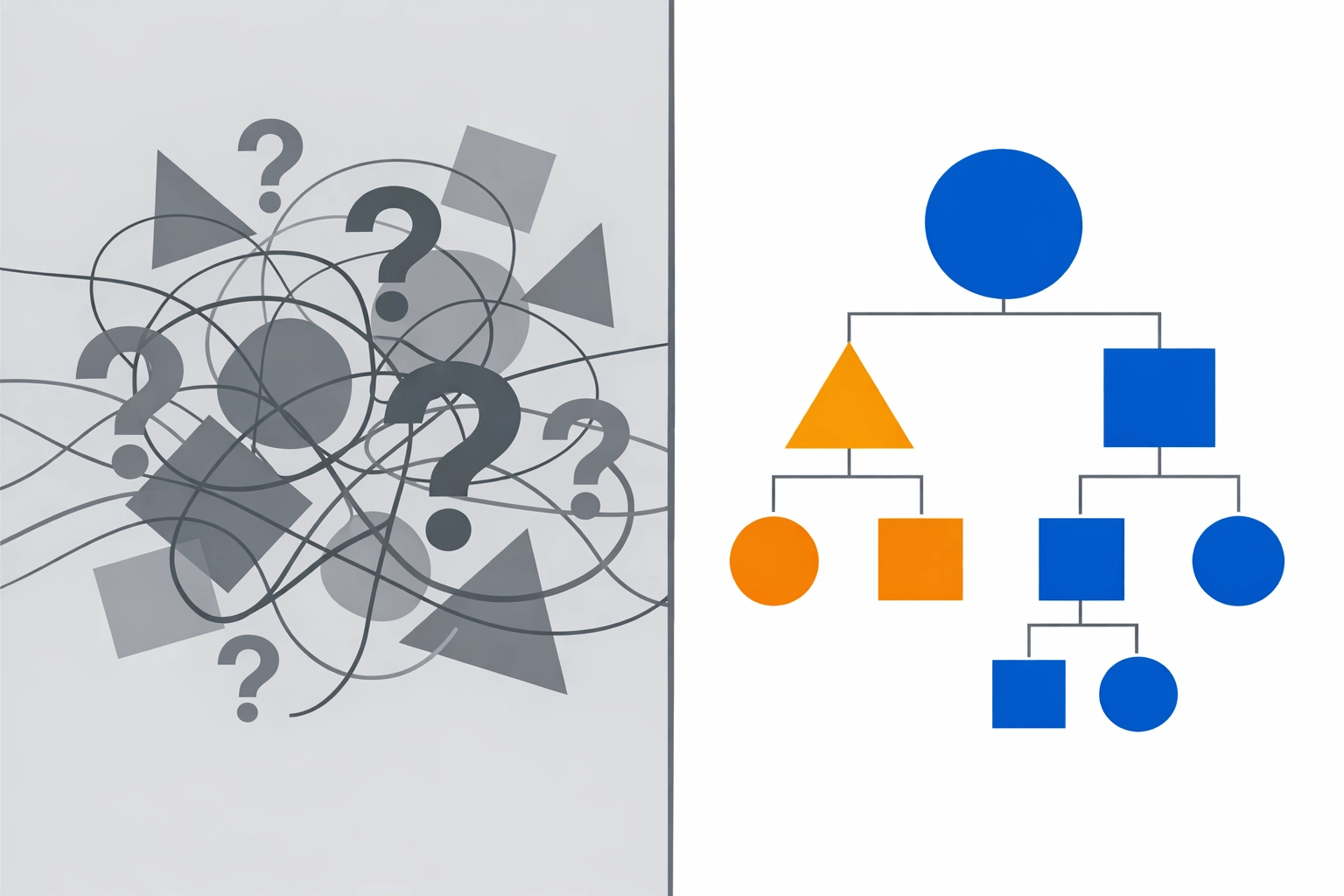
When your assessments become guessing games, here’s what happens:
- Your completion rates look good, but your retention rates tank. Learners “pass” without learning, and three months later, they can’t remember a thing.
- Your data becomes useless. If you can’t trust that a passing score means actual competency, how do you identify knowledge gaps or measure training impact?
- You lose credibility. Nothing signals “check-the-box training” faster than an assessment that insults your learners’ intelligence.
Why Lazy Multiple-Choice Questions (MCQs) Are Killing Your Data in 2026
Let’s talk about why this matters now. In 2026, the L&D world is obsessed (rightfully) with analytics. We’re tracking completion rates, time-on-task, quiz scores, confidence levels, and adaptive pathways. But all of that data is worthless if your assessments aren’t valid.
Here’s the reality: if your MCQs are poorly written, you’re not collecting knowledge data; you’re collecting noise. You can’t personalize learning paths based on faulty assessments. You can’t prove business impact with inflated pass rates. And you definitely can’t justify your training budget when your “certified” employees still can’t perform the skill.
Quality MCQs are the foundation of quality data. Period.
The Anatomy of a Knowledge-Testing MCQ
Every effective multiple-choice question has three components:
- The Stem – The question itself
- The Correct Answer – The one right option
- The Distractors – Wrong answers that seem plausible
Let’s break down how to nail each one.
Writing Stems That Actually Ask Questions
The stem is where clarity begins. A strong stem should allow a knowledgeable learner to answer the question before they even look at the options.
Bad Stem:
“Customer education is…”
Good Stem:
“Which metric best demonstrates the ROI of a customer education program?”
See the difference? The first stem is vague and forces learners to rely on the answer choices to figure out what you’re even asking. The second stem is specific, focused, and tests application-level thinking.
Stem Writing Rules:
- Ask one clear question. Don’t pack multiple ideas into a single stem.
- Front-load the context. Put most of the information in the stem so the answer choices can be short and scannable.
- Avoid negative phrasing. Questions like “Which of the following is NOT a benefit of…” are confusing and penalize careful readers.
- Skip absolute terms. Words like “always,” “never,” “all,” or “none” are red flags that give away the answer.
- Keep it concise. You’re testing knowledge, not reading comprehension.
At Check N Click, we align every MCQ stem with specific learning objectives. If the objective is to “analyze customer engagement trends,” the stem should require analysis, not recall of a definition.

Creating Plausible Distractors for Multiple-Choice Questions (The Game-Changer)
Here’s where most instructional designers drop the ball. Distractors are not just “wrong answers”; they’re believable ones that expose a partial understanding.
A great distractor is one that a learner who almost gets it, but doesn’t quite have mastery, would confidently choose.
The Secret to Writing Plausible Distractors:
Base them on common misconceptions.
Let’s say you’re writing a question about customer onboarding metrics for a SaaS product. The correct answer is “Time to First Value (TTFV).” Here are your distractors:
Weak Distractor:
“Number of login attempts”
(Too obviously irrelevant.)
Strong Distractor:
“Number of features explored in the first week”
(Sounds legit to someone who understands onboarding but doesn’t know the specific terminology of TTFV.)
Additional Distractor Best Practices:
- Keep all options the same length and complexity. If one option is a full sentence and the others are single words, the outlier will stand out.
- Make options mutually exclusive. No overlap, no ambiguity.
- Match grammar and formatting. If the stem ends with “a,” all options should start with a consonant.
- Avoid “All of the Above” and “None of the Above.” These are lazy shortcuts that undermine the validity of your question.
Pro Tip: Review your learners’ actual mistakes during pilot testing. Their wrong answers are goldmines for creating realistic distractors in future iterations.

Advanced Tips from 13 Years in the Trenches
After developing custom eLearning for hundreds of clients across industries, here’s what we’ve learned about writing multiple choice questions that actually work:
1. Write Questions as You Teach, Not After
Don’t wait until the end of the module to write your assessment. Draft MCQs while you’re designing the lesson. This ensures alignment between what you’re teaching and what you’re testing.
2. Use 3-5 Options (No More, No Less)
Four options are the sweet spot for most questions. Fewer than three makes guessing too easy; more than five adds cognitive load without improving validity.
3. Ask a Peer to Review
You’re too close to your own content. A fresh set of eyes will catch ambiguous wording, unintentional clues, or distractors that don’t actually distract.
4. Test at Higher Cognitive Levels
Recall-level questions (“What is the definition of…”) have their place, but application and analysis questions (“Which approach would you use in this scenario…”) are far more predictive of real-world performance.
5. Iterate Based on Item Analysis
After your assessment is live, review the item analysis data. If 95% of learners are getting a question right, it’s too easy. If only 20% are getting it right, it’s either too hard or poorly written. Aim for a difficulty range of 50-80% correct.
The 2026 Multiple-Choice Questions (MCQs) Writing Checklist
Before you publish that assessment, run through this checklist:
✅ Stem is a complete, clearly stated. question
✅ Stem includes all necessary context
✅ Stem avoids negative phrasing and absolute terms
✅ Correct answer is unambiguously correct
✅ Distractors are plausible and based on common misconceptions
✅ All options are similar in length, complexity, and grammar
✅ No “All of the Above” or “None of the Above.multiple-choice“
✅ No grammatical or formatting clues
✅ Question aligns with a specific learning objective
✅ Question tests application, not just recall
Want a Deeper Dive into Multiple-Choice Questions (MCQs)? Try Our Udemy Course
Here’s the thing: if you want to level up your MCQ writing faster (and stop second-guessing every stem and distractor), our Udemy course is a solid next step.
Course: Writing Effective Quiz Questions
It’s a deep dive built from our 13+ years of experience developing assessments for Fortune 500 teams and fast-moving SaaS companies—packed with practical examples you can copy, tweak, and ship.
Your Assessments Are Only as Good as Your Questions
Here’s the bottom line: in a world drowning in AI-generated content and “instant eLearning,” the quality of your assessments is your competitive edge. Anyone can throw together a slide deck and a quiz. But writing multiple-choice questions that genuinely measure competency? That takes strategy, empathy, and expertise.
At Check N Click, we’ve built our reputation on crafting assessments that don’t just check boxes: they drive behavior change and prove ROI. If you’re tired of meaningless completion metrics and ready to build customer education that actually sticks, let’s talk.
Because your learners deserve better than guessing games. And so does your data.
Want to see how we apply these principles? Check out our case studies to see the impact of expertly-designed assessments in action.