Scaling a successful customer education program requires you to stop guessing what your users need. Let’s be real: most of us in the SaaS and EdTech world are guilty of building training based on our own assumptions, (we see you!), rather than the actual, messy reality of our users' daily struggles. We think we know the "right" way to use our product, so we build a comprehensive course that covers every single button and feature.
The result? Ghost-town completion rates and users who still don't know how to solve their problems.
If you’ve ever felt like you’re shouting into the void with your training content, it’s time to apply a secret weapon from the startup world: The Mom Test. Originally penned by Rob Fitzpatrick for entrepreneurs, its principles are a literal gold mine for Product Managers and Customer Success leads who want to master customer education.
Why Your Training Might Be Failing (And It’s Not the Content)
Here’s the deal: most "feedback" you get from users is garbage. Not because they’re mean, but because they’re too nice. When you ask a customer, "Do you think this new onboarding course would be helpful?" they’ll almost always say "Yes." Why? Because it’s the polite thing to do.
In the world of customer education instructional design, this is called a "false positive." You spend three months building a complex curriculum, only to find out that while users said they’d use it, they don't actually have the time or the specific problem the course solves.
We need to stop asking for opinions and start hunting for facts. What’s the real impact of your current training? If it isn't moving the needle on your KPIs, it's just noise.

Alt-text: A diagram illustrating the gap between user feedback and actual user behavior in customer education.
The Compliment Trap in Custom eLearning Development
Let’s talk about the most dangerous thing in your design process: the compliment. When you’re in the middle of custom eLearning development, it’s incredibly tempting to hop on a Zoom call with a "friendly" client, show them a few slides, and bask in their praise, (hello, endless Zendesk tickets!): only to realize later that they haven't actually learned anything.
Compliments are the "participation trophies" of the corporate world. They feel good, but they don't help you build a better product. When a customer says, "I love the look of this training," they are essentially giving you a pat on the head. They aren't telling you if the training will actually prevent them from calling support at 4:00 PM on a Friday.
To avoid this trap, you need to redirect the conversation away from your training idea and back toward their life. Instead of asking what they think of your instructional design, ask them about the last time they felt frustrated using your software.
The Three Rules of The Mom Test for Educators
How do we actually apply this? Fitzpatrick’s framework boils down to three simple rules that we can adapt for the customer education space.
1. Talk About Their Life, Not Your Idea
Instead of pitching a 10-module course on "Advanced Analytics," talk to your users about how they currently report data to their bosses.
- Don't ask: "Would you watch a video on our reporting dashboard?"
- Do ask: "Walk me through how you prepared your last monthly report. Which parts took the longest?"
By focusing on their workflow, you discover that they don't need a video on the dashboard: they need a template for Excel. That’s a massive insight that saves you weeks of wasted development time.
2. Ask About Specifics in the Past
Humans are terrible at predicting their future behavior. We all think we’ll go to the gym tomorrow and watch that 2-hour webinar on data security. (Spoilers: we won’t.)
When gathering requirements for customer education, always ask for concrete examples of past behavior.
- Don't ask: "How often would you use a searchable knowledge base?"
- Do ask: "The last time you got stuck on a feature, what was the very first thing you did to find an answer?"
If they say they searched Google or asked a colleague instead of looking at your existing help docs, you know you have a discoverability problem, not necessarily a content problem.
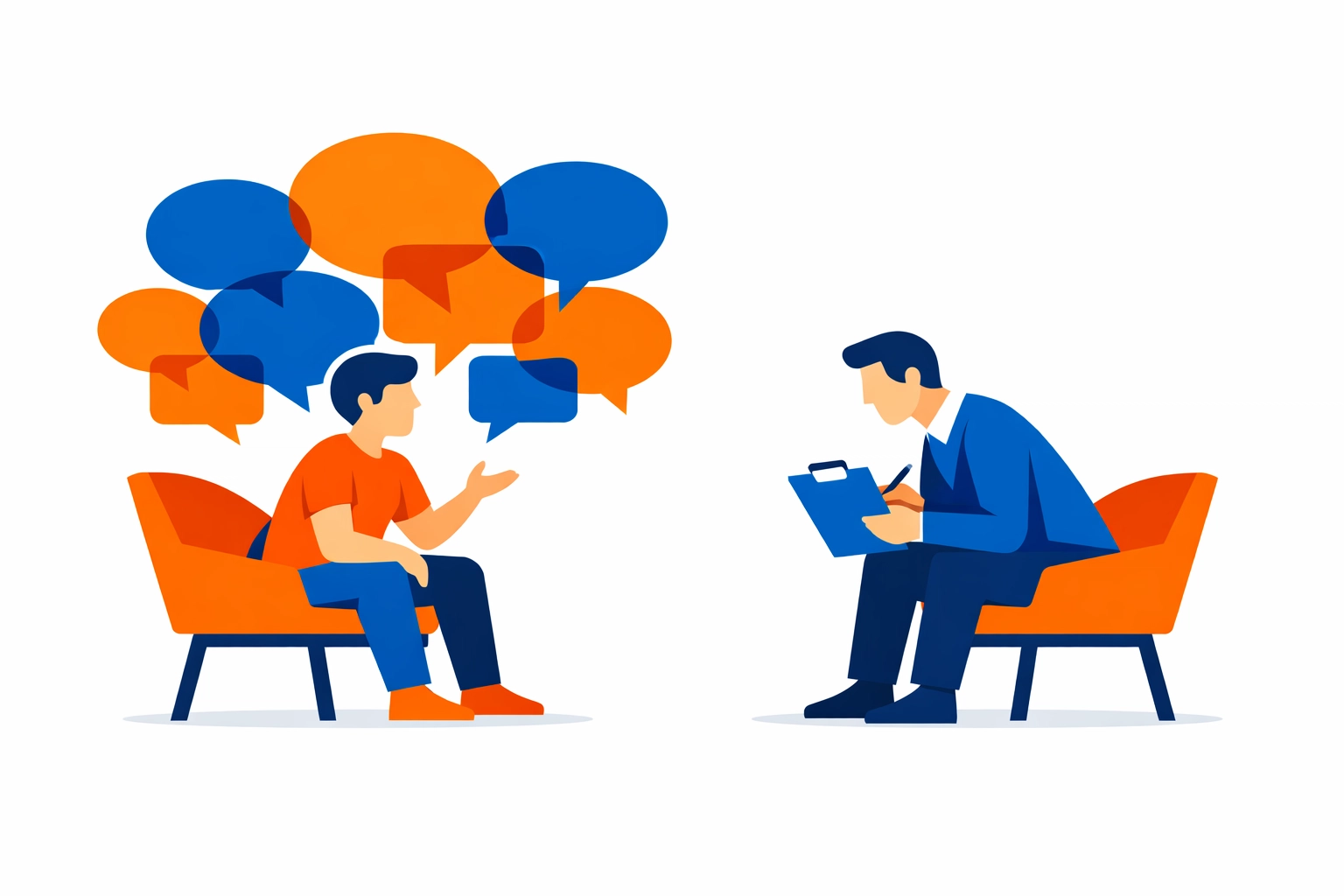
Alt-text: A professional researcher conducting an interview to improve customer education strategies.
3. Talk Less, Listen More
As experts in our own products, we love to talk. We love to explain features. But in the research phase of custom eLearning development, your job is to be a sponge.
If you’re doing 80% of the talking in a discovery call, you aren't learning. You're selling. And you can't build effective training on a sales pitch. You need to uncover the "workarounds": those weird, inefficient things users do because they don't understand the "proper" way yet. Those workarounds are your roadmap for what to teach.
Turning Conversations into Curricula
Once you’ve gathered real data (the kind your mom couldn't lie about), it’s time to build. This is where high-level frameworks like ADDIE or SAM come into play.
But here's the "real talk" moment: even the best framework won't save a project built on bad assumptions. You need to ensure your learning objectives are tied directly to those "pain points" you uncovered. If your users said they struggle with "Initial Setup," your first module shouldn't be "The History of Our Company." It should be "Getting You Live in 5 Minutes."
Why does this matter? Because when customer education solves a real problem, you don't have to beg people to take it. They’ll seek it out.
The Real ROI of Asking the Right Questions
What's the real impact of a "Mom-Tested" education strategy?
- Reduced Churn: Users who know how to get value from your tool stay.
- Lower Support Costs: Every "How-To" question answered by a course is one less ticket for your support team.
- Faster Time-to-Value: If you know exactly where users trip up, you can build the "bridge" they need to succeed faster.
Don't feel pressured to build a massive university overnight. Start with one small, validated problem. If you aren't sure where to start, you can even use an ROI calculator to see where your training investment will have the biggest impact.

Alt-text: A business professional reviewing data to measure the ROI of customer education.
Let’s Stop Guessing Together
Building customer education is hard. Building it based on assumptions is impossible. By using The Mom Test, you move from being a "content creator" to a "problem solver." You stop being the person who makes "those boring compliance videos" and start being the person who makes the product actually work for the people using it.
At Check N Click Learning and Technologies Pvt. Ltd., we specialize in taking those messy user insights and turning them into streamlined, effective learning experiences. We’ve seen firsthand how a shift in questioning can transform a failing project into a powerhouse for growth.
Ready to stop guessing and start building training that actually works? Check out our portfolio to see how we've helped other companies scale their educational efforts, or book some time with Lokesh to talk about your specific challenges.
No compliments allowed: just real solutions for real problems. (But seriously, your current ideas are probably great… we just want to make sure they’re effective!)
Focus on the facts, listen to your users, and remember: if your mom says she'd take your course, she's probably lying. Go find the truth instead!