Let’s talk about why your Instructional Design processes don’t matter to your stakeholders if you aren’t solving a problem.
Let’s be real: your Subject Matter Experts (SMEs) and business stakeholders don’t wake up in the morning wondering if you’re using the Successive Approximation Model (SAM) or if you’ve perfectly aligned your content with the fifth event of Gagne’s Nine Events of Instruction. They wake up wondering why the support tickets are through the roof or why the new software feature isn’t being used by customers.
We get it. As L&D professionals, we are proud of our methodology. We love a good ADDIE cycle. But there is a time to preach the gospel of ID, and there is a time to put the textbook in the shredder and just get things done. If you spend your first meeting with a stressed-out Product Manager explaining the nuances of cognitive load theory instead of asking how to stop the “bleeding,” you’ve already lost them.
![[Instructional Design processes] hero](https://cdn.marblism.com/TPiHUMDQXaN.webp "[Instructional Design processes] hero")
The Reality of Instructional Design Processes in the Wild
Here’s the deal: SMEs are experts in their domain, not in ours. When we force them to navigate our internal Instructional Design processes, we are essentially asking them to do a second job. They have demanding full-time roles (hello, endless Zendesk tickets) and limited patience for L&D jargon.
Research shows that SMEs often find ID terminology confusing. Instead of asking about “learning objectives” or “terminal behaviors,” why not just ask, “What is the one thing they need to do differently tomorrow?”
At Check N Click, we’ve seen that the most successful projects aren’t the ones where we followed a 12-step process to the letter, but the ones where we pivoted to solve a high-stakes business problem at lightning speed. Sometimes, the “best practice” is the one that gets a solution into the learner’s hands before the crisis doubles in size.

Alt Text: A professional discussing [Instructional Design processes] with a stakeholder in a modern office setting.
Scenario 1: The “Fire Drill” Product Launch
Imagine this: A new, high-priority feature drops tomorrow. Your customers have zero idea how it works, and the sales team is already promising it to everyone. This is a classic “fire drill.”
In a perfect world, your Instructional Design processes would dictate a 4-week analysis phase, followed by a storyboard review, a prototype, and a beta test. But in the real world? The feature is live in 24 hours. If you insist on your full process, you’ll deliver a beautiful course three weeks after the customers have already given up and moved to a competitor.
The Fix: Forget the analysis phase. Forget the “Mastering Our Platform” 10-module course. Create a 2-minute “Quick Start” video or a single-page interactive job aid.
Why it works: You solved the immediate hurdle. The business problem wasn’t “lack of deep knowledge”; it was “immediate inability to use a tool.” Solving the learner’s immediate frustration is the highest form of instructional design, even if it skips ten steps of your standard process.
Scenario 2: The Churn Crisis
Let’s look at another one. Your SaaS company is seeing a spike in churn. Why? Because users are leaving the platform because they can’t find the “Export” button (we see you, frustrated users!).
Your boss suggests a comprehensive customer education program. Your ID brain starts tingling: you want to map out a full learner journey, conduct interviews, and build a tiered certification program.
The Fix: Stop. Right. There. If people can’t find a button, they don’t need a certification. They need a UI/UX fix or a micro-tutorial that pops up exactly when they hover over the area.
By focusing on the UI friction instead of an elaborate course, you save the company money and save the customers’ time. In this case, adhering to traditional Instructional Design processes would actually be a disservice. You’d be building a bridge where people just needed a flashlight. (Think Netflix binge, but not in a good way: nobody wants to “binge-watch” training just to find a settings menu).

Alt Text: A dashboard showing churn metrics and how [Instructional Design processes] can be simplified for quick wins.
Scenario 3: The Compliance Gap
This is the big one. When a safety issue is costing the company thousands of dollars in fines or: heaven forbid: putting lives at risk, nobody wants to hear about your “discovery phase.”
If there’s a recurring safety violation in a warehouse, your priority is immediate corrective action. If you spend three weeks debating the “aesthetic consistency of the slide deck” while people are getting hurt, you’ve missed the point of your job.
The Fix: Immediate, punchy, “Do This, Not That” training. Use SMS alerts, posters with QR codes, or a 30-second mobile-first simulation.
The Reality: We all love a perfectly mapped Gagne’s 9 Events of Instruction, but when the building is metaphorically on fire, you don’t teach a class on the history of combustion. You point to the exit. Professionalism in L&D means knowing when the “rules” of Instructional Design processes are actually obstacles to safety and ROI.
Why Rigid Instructional Design Processes Kill Agility
What’s the real impact of being too attached to your process? You become the “Department of No” or, worse, the “Department of Slow.”
When stakeholders feel like talking to L&D is a bureaucratic nightmare, they stop coming to you. They start building their own “rogue” training: usually ugly PowerPoint decks with too much text: because they can get it done in an afternoon.
We’ve seen it happen time and again. The more we talk about our process, the less they hear about our value. At Check N Click, we pride ourselves on being “problem-first.” Whether we are working on Higher Logic development or custom eLearning services, our first question is always: “What is the business goal?”
If the goal can be reached faster by skipping a formal storyboard phase and going straight to a prototype, we do it. That’s how you build trust.
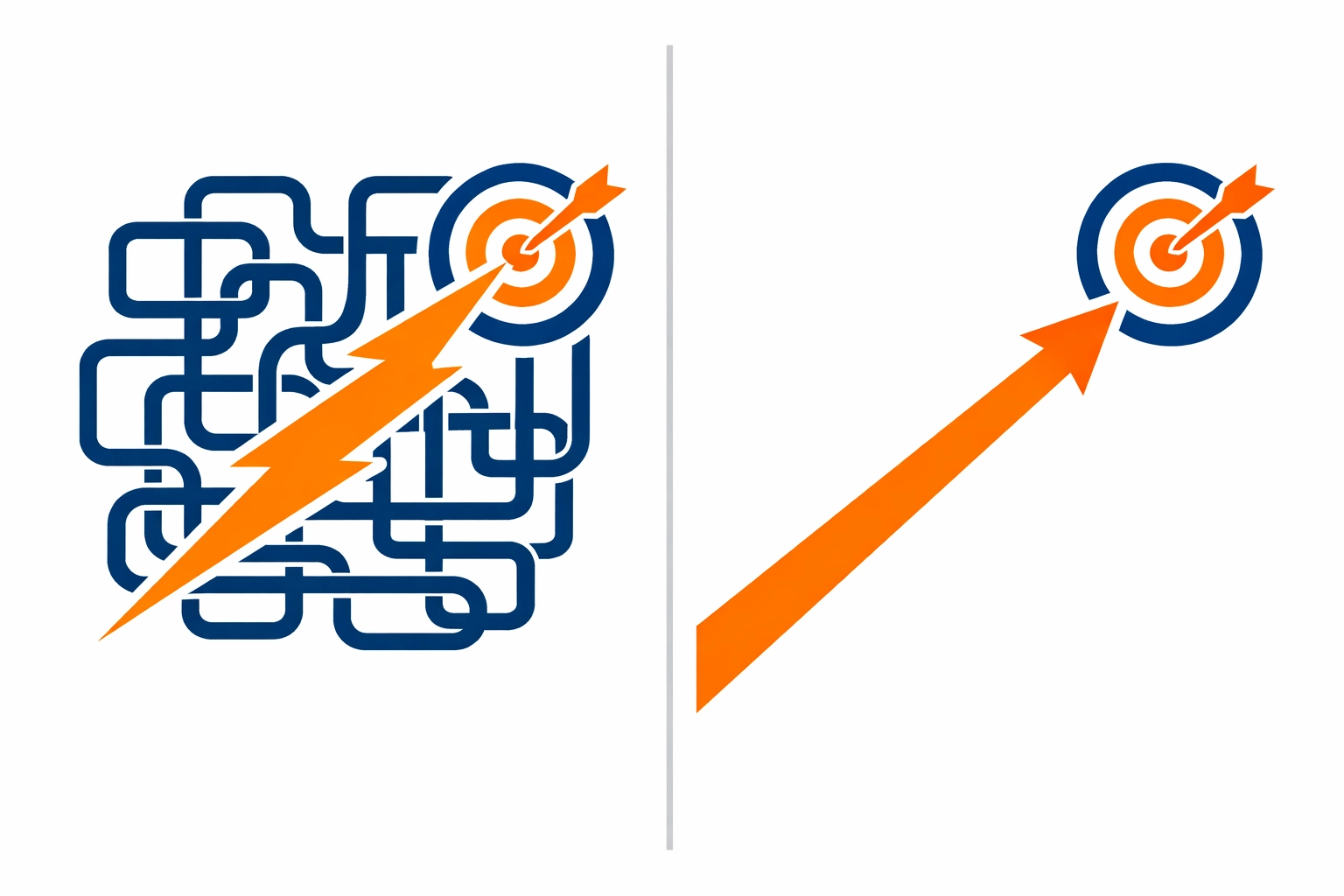
Alt Text: A comparison chart of traditional [Instructional Design processes] vs. agile problem-solving.
Knowing When to Revive Your Instructional Design Processes
Now, don’t get us wrong. We aren’t saying you should never use a process. That would be chaos. You don’t want to be “flying blind” on a massive, 6-month enterprise-wide transformation.
Use your full, robust Instructional Design processes when:
- The project has a high budget and long-term shelf life.
- The subject matter is incredibly complex and requires deep scaffolding.
- You are building a foundational “Academy” style experience from scratch.
But for everything else? Be the person who solves the problem, not the person who quotes the handbook.
Bridging the Gap: The Check N Click Way
At Check N Click Learning and Technologies Pvt. Ltd., we’ve mastered the art of “Invisible ID.” We use the most sophisticated Instructional Design processes behind the scenes, so our clients don’t have to.
We don’t bore our stakeholders with jargon. Instead, we show them case studies of how we’ve moved the needle on performance. We focus on outcomes, not just delivering content. Because at the end of the day, a “gold star” for following ADDIE doesn’t pay the bills: but a 20% reduction in support tickets does.

Alt Text: A team collaborating on solving a business problem without getting bogged down by [Instructional Design processes].
Final Thoughts: Be a Partner, Not a Professor
Here’s the thing: your SMEs are your biggest allies, but only if you respect their time. When you junk the theory-speak and focus on their pain points, you transition from being a “vendor” to being a strategic partner.
Stop trying to prove how much you know about learning science and start proving how much you care about the company’s success. Your stakeholders will thank you, your learners will actually learn, and you might just find that your job gets a whole lot easier.
Ready to stop talking about theory and start solving problems?
- Check out our Work Samples to see how we tackle real-world challenges.
- Book time with Lokesh to discuss your next project( no jargon promised!)