Digital human avatars are exploding in custom eLearning development, and if you’re a Customer Success Manager or an Instructional Designer, you’ve probably asked yourself: Can a synthetic face really replace a real instructor?
Here’s the thing: your customers don’t care whether the person on screen is “real” or AI-generated. They care about learning faster, retaining more, and actually enjoying the experience. And the data? It’s starting to tell a fascinating story about empathy, scalability, and ROI that challenges everything we thought we knew about effective SaaS training and custom eLearning development.
Let’s dig into the real question: Does fake empathy actually work? And, more importantly, should you invest in digital human avatars for your customer training programs, SaaS training, and custom eLearning development?
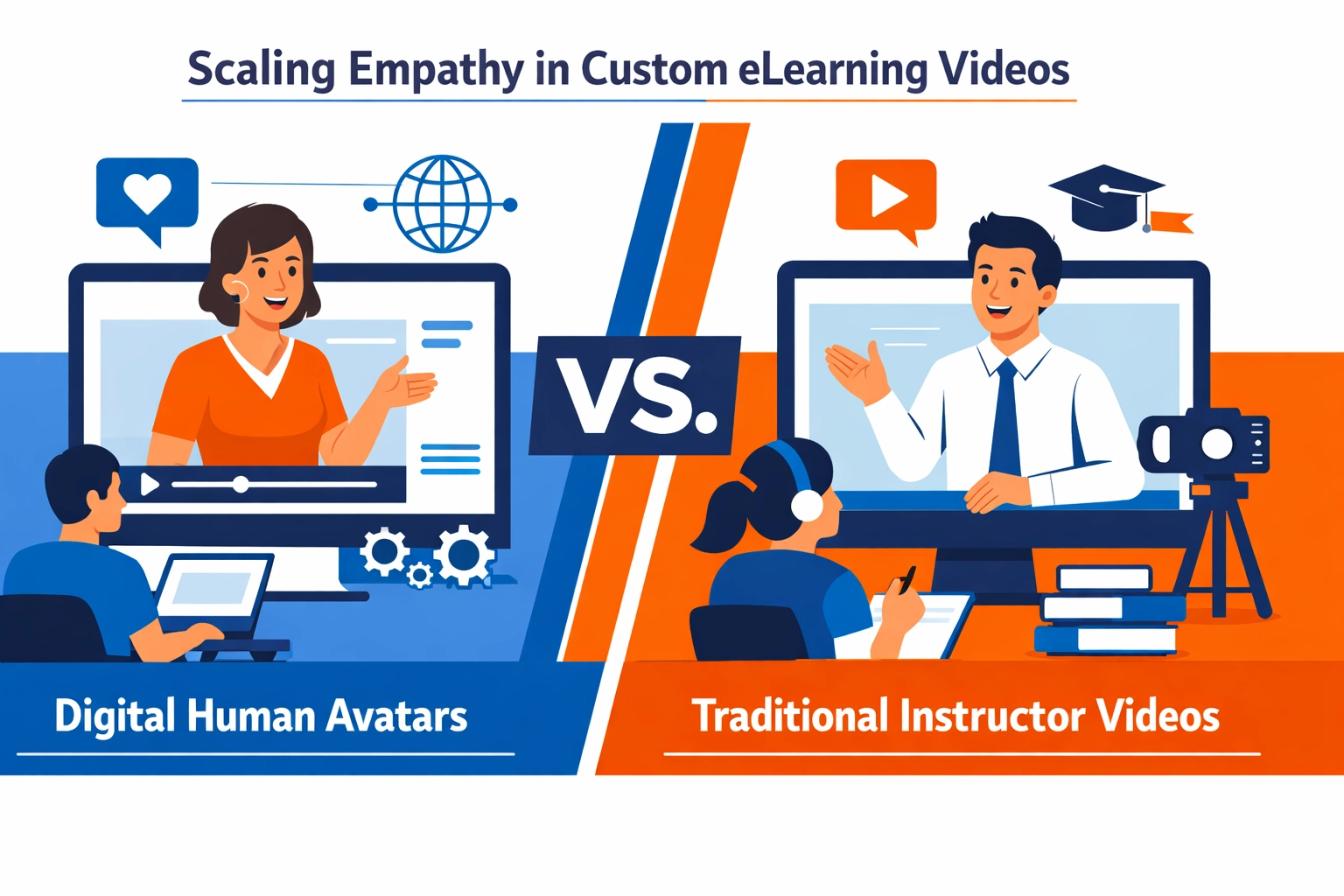
The Empathy Problem in Automated SaaS Training
Let’s be real: most eLearning solutions feel robotic. Static slides with monotone voiceovers. Text-heavy modules that scream “compliance course from 2008.” Animated characters that look like they escaped from a 90s CD-ROM game.
Your Customer Success team knows the pain; customers complete the training because they have to, not because they want to. Completion rates are up, but engagement? Flatlined.
Traditional instructor videos tried to solve this. Put a friendly face on camera, add some personality, and create a human connection. It worked… until you needed to scale. Suddenly, you’re managing video production schedules, dealing with lighting inconsistencies, and re-shooting entire modules because one product feature changed (hello, endless Zendesk tickets).
Enter digital human avatars: AI-generated presenters that look, sound, and even express emotions like real instructors, but exist entirely in software.
The promise? Human-like empathy at machine scale.
The skepticism? Can pixels on a screen really replace genuine human connection in instructional design?

What the Research Actually Says About Avatar Expressiveness
Here’s where it gets interesting. Recent studies on virtual avatar expressiveness show a positive effect on learning outcomes, emotional experience, and user engagement. Not “slightly better”, measurably better retention and satisfaction scores.
The secret? It’s not about being “real.” It’s about being present.
Research confirms what Customer Success Managers already know intuitively: students are more inclined to listen, connect with content, and retain information when there’s a visible face, whether human or avatar-based. The brain responds to facial expressions, eye contact, and tone regardless of the source.
Think about it: your customers don’t know (or care) whether that friendly voice explaining your SaaS platform is recorded by a human in a studio or generated by an AI from a text script. What matters is whether that voice:
- Sounds natural and conversational (not like Siri reading a Wikipedia entry)
- Makes eye contact and uses facial expressions appropriately
- Feels like a patient teacher, not a frustrated tech support agent
Some digital human avatars in 2026 nail all three. And they do it at a fraction of the production cost and time of traditional instructor videos.
Scalability in Custom eLearning Development: Production Reality
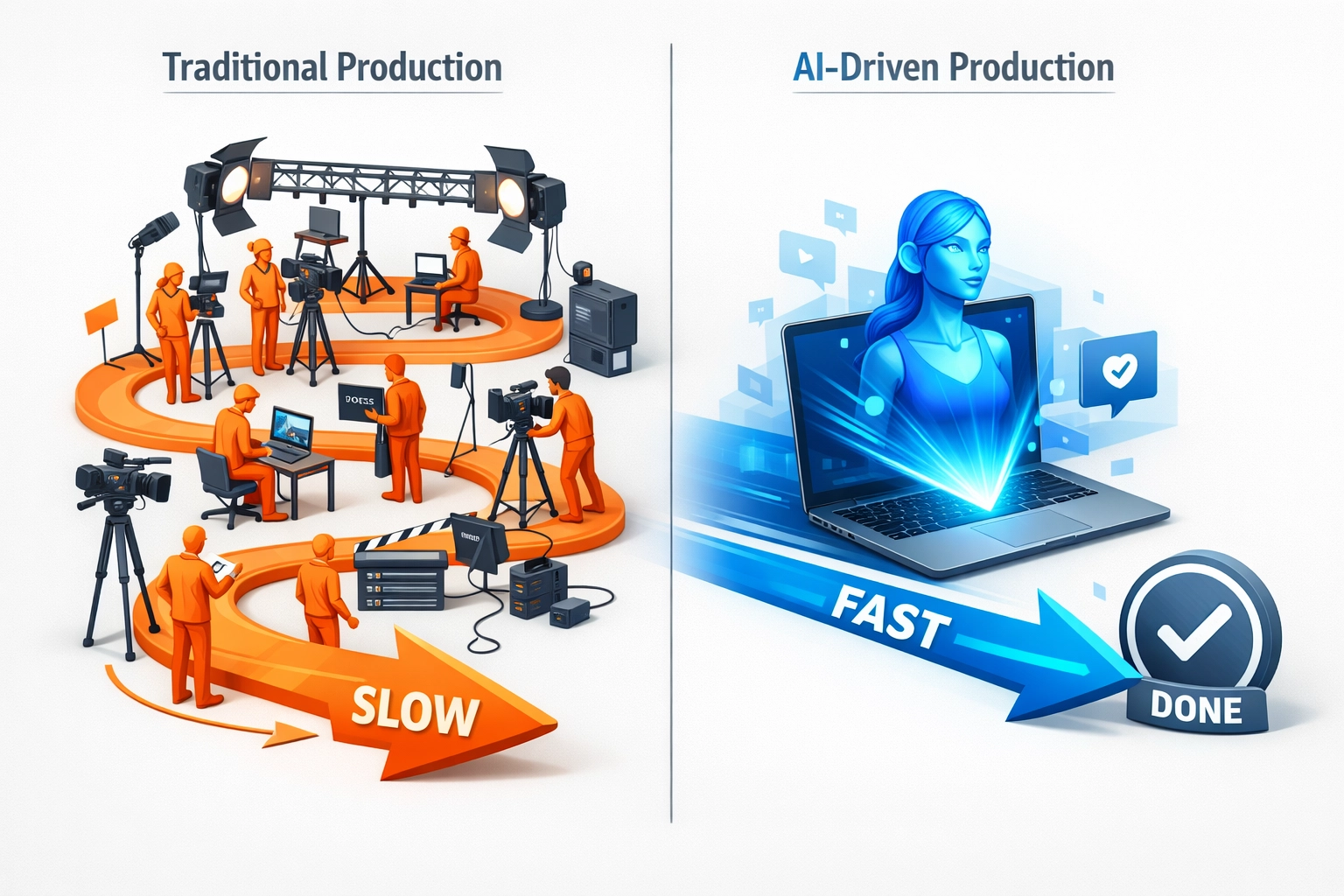
Let’s talk about the elephant in the room: traditional video production is expensive and slow.
You need:
- Professional equipment (cameras, lighting, microphones)
- A studio or well-lit recording space
- An actual human instructor (who needs scheduling, may get sick, might leave the company)
- Video editing software and expertise
- Reshoot capability when content changes (and it always changes)
For a single 10-minute training video, you’re looking at 2-4 weeks of production time and anywhere from $3,000 to $10,000, depending on quality (check out our comprehensive guide to custom eLearning development costs for the full breakdown).
AI avatar videos? Input text, select an avatar, generate professional-quality content in hours. Cost per video can drop to under $500.
But here’s what most people miss: the real ROI isn’t just in the initial production. It’s in the agility.
When your SaaS platform updates its UI (which happens quarterly if you’re moving fast), you can regenerate avatar videos with updated content in a day. Traditional instructor videos? You’re looking at weeks of scheduling and reshooting. Your customer training programs become outdated before they even launch.
Personalization at Scale: The SaaS Training Advantage
Here’s where digital human avatars absolutely destroy traditional videos: personalized learning pathways.
Imagine creating branching storylines with dozens of video segments for interactive, decision-based learning experiences. With traditional video production, this is prohibitively expensive. You’d need to shoot every possible scenario variation.
With avatars? Generate variations on demand.
Your Customer Success team can now offer:
- Multilingual training with the same avatar speaking fluent Spanish, German, or Japanese (without hiring multiple instructors)
- Role-specific content where the avatar addresses different user personas by name and job function
- Adaptive responses that change based on how the customer is progressing through the material
This isn’t science fiction, it’s happening right now in custom eLearning development and SaaS training for enterprise SaaS companies.
The avatar can represent different cultures or educational environments to match learner needs. Traditional videos require entirely new production shoots for this level of customization. Avatars? Update the script and regenerate.
The “Uncanny Valley” Problem (And Why It’s Fading Fast)
Let’s address the obvious concern: what about that creepy, not-quite-human feeling?
The “uncanny valley”, that unsettling reaction when something looks almost human but not quite, was a legitimate problem with digital avatars even two years ago. Early AI-generated faces had dead eyes, unnatural lip-syncing, and robotic gestures that screamed “THIS IS FAKE.”
In 2026? The gap is closing fast.
Modern digital human avatars use:
- Advanced neural rendering for realistic skin textures and micro-expressions
- Natural language processing that matches facial expressions to emotional tone
- Motion capture data from real humans to replicate authentic body language
Are they perfect? Not yet. But here’s the reality check: they don’t need to be.
Your customers aren’t watching SaaS training to critique CGI quality. They’re trying to learn how to use your product faster. As long as the avatar is “good enough” to not be distracting, the content quality and instructional design matter infinitely more than whether the presenter is flesh-and-blood.

The Content Complexity Trade-Off Nobody Talks About
Here’s something the research reveals that’s important for Experience Designers: as content depth and difficulty increase, cognitive load rises, and this affects both avatar and traditional videos equally.
Complex technical training with deep product functionality can cause frustration and reduced engagement regardless of the delivery format. The avatar doesn’t magically fix bad instructional design.
What does this mean practically?
Don’t use digital human avatars (or traditional videos) as a band-aid for poorly structured content. You still need:
- Clear learning objectives
- Logical content flow
- Practice opportunities and knowledge checks
- Chunked information (nobody retains 45-minute lecture dumps)
The avatar is a delivery mechanism, not a replacement for solid instructional design principles. (We see you, teams trying to slap an AI face on existing PowerPoint slides and calling it “next-gen training.”)
ROI of Avatars in Custom eLearning Development
So what’s the actual business impact for SaaS training and custom eLearning development? Let’s get specific.
Customer Success Managers using digital human avatars in their onboarding programs are reporting:
- 40-60% reduction in video production time (measured in weeks to days)
- 70% lower cost per training video after initial setup investment
- 30% higher completion rates compared to text-based or static slide courses
- Faster time-to-value because content updates happen in hours, not weeks
The empathy element? Customers describe avatar-led training as “more engaging than reading documentation” and “surprisingly personal.” The “surprisingly” part is key; expectations were low, but the experience exceeded them.
One enterprise SaaS company we work with replaced its entire library of talking-head videos with AI avatars and saw time-to-first-value improve by 23%. Why? Because they could update training content in sync with product releases instead of lagging weeks behind.
When Traditional Instructor Videos Still Win
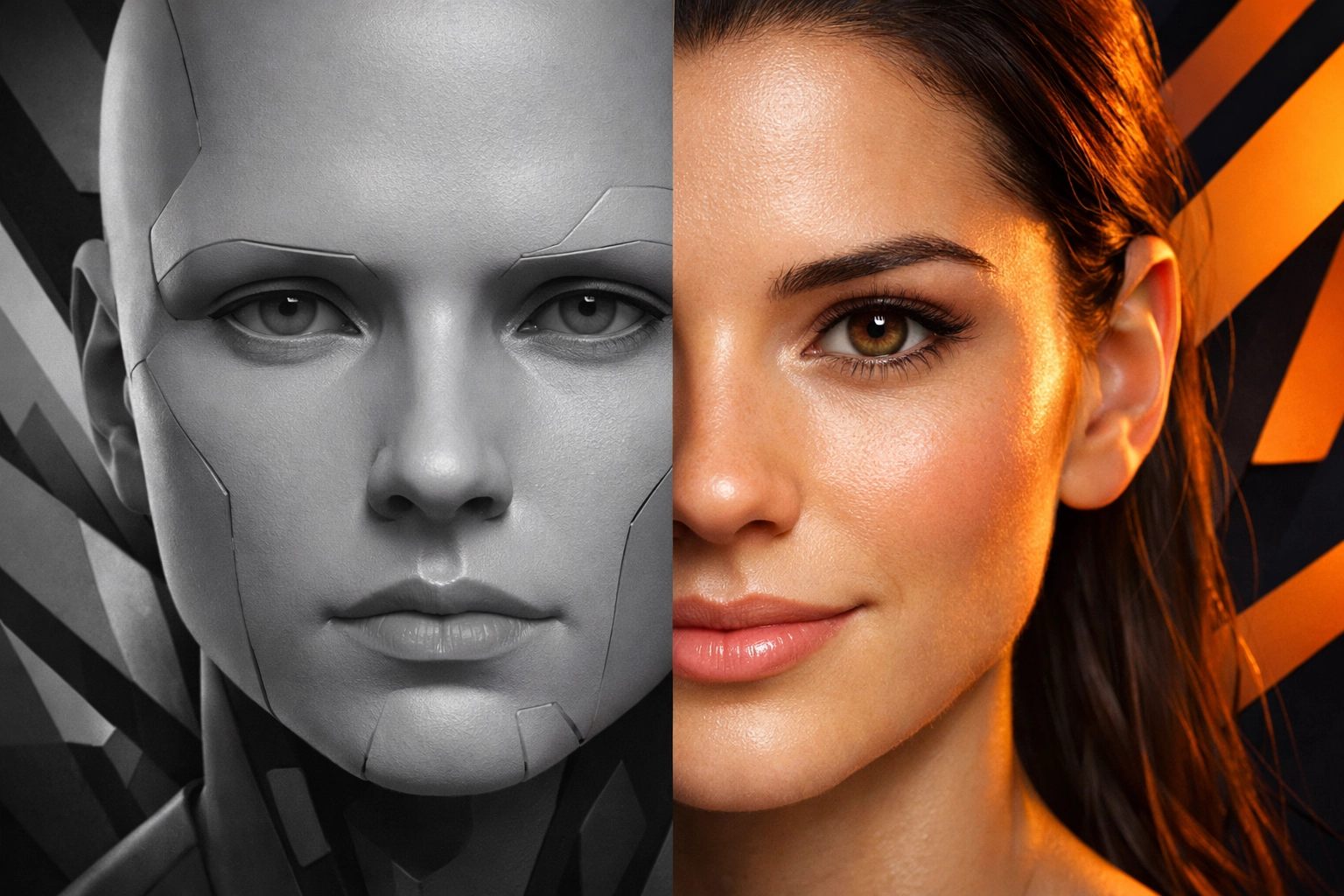
Let’s be honest: digital human avatars aren’t the right choice for every scenario.
Traditional instructor videos still make sense when:
- Brand personality is paramount (your CEO’s quarterly update should probably be… your CEO)
- Complex demonstrations require real hands (showing physical product manipulation)
- Human credibility is critical (compliance training signed off by your General Counsel carries more weight with their real face)
- You have ONE flagship course that won’t change frequently (the production investment makes sense)
But for the bulk of your customer education strategy? The scalability, agility, and cost-effectiveness of digital human avatars are game-changing.
Pros and Cons: Breaking Down the Two Approaches
Let’s do some real talk: in custom eLearning development, there’s no “perfect” format—just the one that fits your reality (budget, timelines, update frequency, and how fast your product team loves shipping changes).
Digital Human Avatars (for custom eLearning development + SaaS training)
Pros:
- Scalability: Build once, roll out across teams/regions without begging for more studio time.
- Cost-effectiveness: Lower cost per video, especially when you’re producing a lot of modules.
- Multilingual support: Same avatar, multiple languages (without hiring five different presenters).
- Agility for updates: UI change? Script tweak? Regenerate and ship (before your helpdesk melts).
Cons:
- Minor uncanny valley risks: It’s way better in 2026, but “almost human” can still feel weird if you pick the wrong avatar or voice.
- Less brand authority for leadership: If it’s a leadership message, an avatar can feel like a substitute teacher.
Traditional Instructor Videos (in custom eLearning development)
Pros:
- High human warmth: Real people bring natural authenticity (the kind you can’t fully fake yet).
- Brand credibility: Great for executive messages, SMEs, and anything that needs “trust me, I’m real.”
- Great for physical demos: When hands-on demos matter, humans win.
Cons:
- High cost: Production adds up fast (gear, edits, re-shoots—the whole circus).
- Slow production: Schedules, approvals, re-takes… it’s not exactly “ship it today.”
- Difficult to update or scale: One product tweak can force a full re-record (and nobody wants that).
Making the Call: Avatar or Instructor?
Here’s how to decide for your specific use case:
Choose digital human avatars when:
- You need to scale training across multiple languages or regions
- Content updates frequently (monthly or quarterly)
- Budget or timeline constraints make traditional production impossible
- Personalization at scale is a strategic priority
- You’re building branching, interactive learning experiences
Stick with traditional instructor videos when:
- Executive presence or subject matter expert credibility is essential
- Content is evergreen (changes less than once per year)
- Physical demonstrations are required
- Your brand identity is inseparable from specific human personalities
Most companies? You’ll use a hybrid approach. Strategic flagship courses with traditional instructor videos, and scalable product training, onboarding sequences, and feature releases with digital human avatars.

The Bottom Line on Empathy at Scale in SaaS Training
Does “fake” empathy drive real results? The data says yes: when executed well.
Digital human avatars aren’t replacing human connection in learning. They’re democratizing professional-quality, engaging training for companies that couldn’t otherwise afford or scale it.
For Customer Success Managers drowning in onboarding tickets and Experience Designers trying to keep pace with product velocity, avatars solve a real problem: how do you create empathetic, engaging eLearning solutions that actually scale?
The answer isn’t “real vs. fake.” It’s effective vs. ineffective. And in 2026, a well-designed AI avatar can be more effective than a poorly produced traditional video shot by a nervous intern in a conference room.
Your customers don’t care about the technology. They care about learning your product quickly and painlessly. Give them that experience: whether it’s delivered by pixels or people: and you win.
Ready to explore digital human avatars for your customer training programs? Let’s talk about custom eLearning development that scales with your business( without sacrificing the human touch your customers deserve.)